

You Were Never Too Much
You Were Just Early

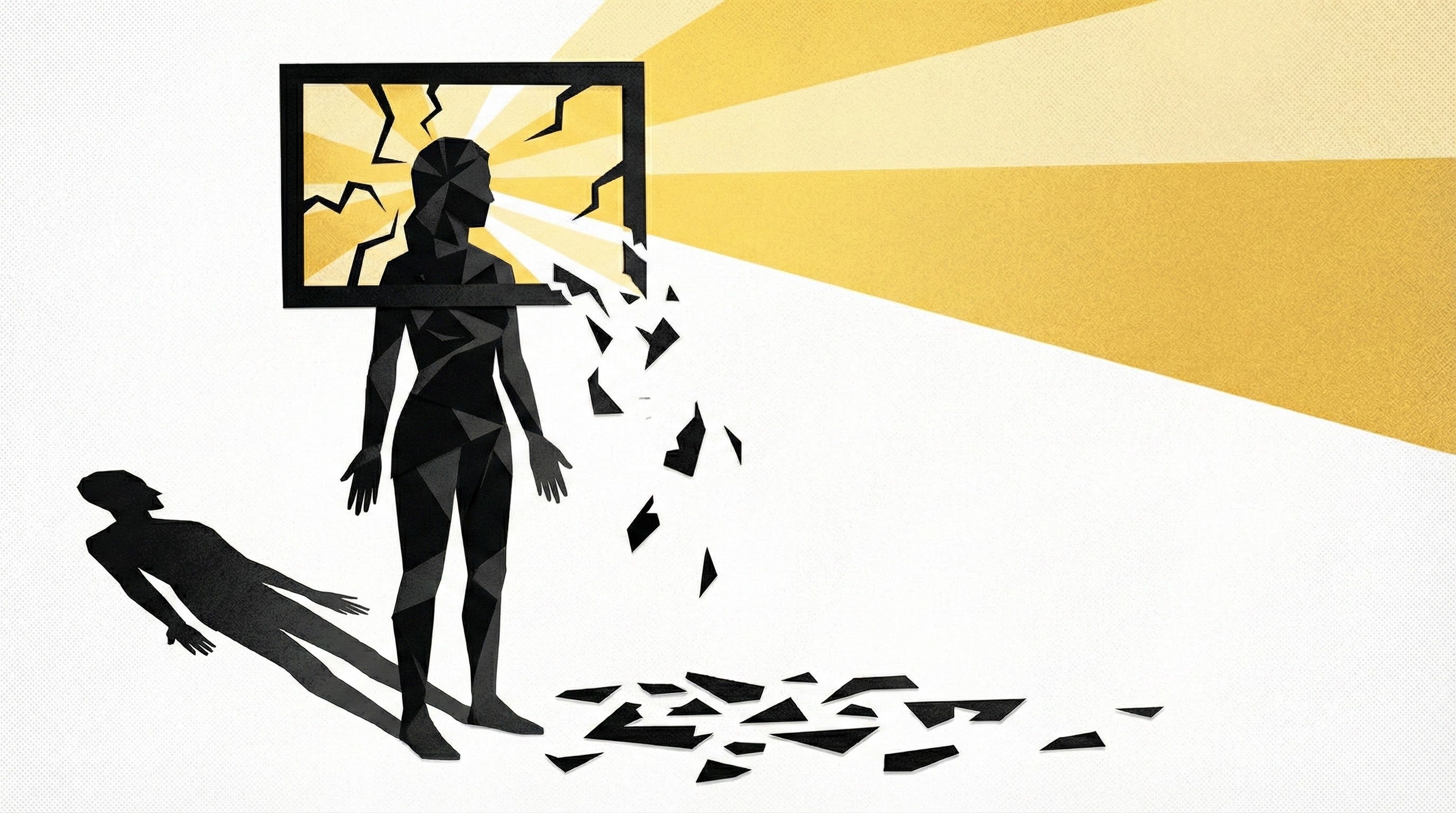
Somewhere along the way, somebody told you that you think too much.
Maybe it was a boss. Maybe a teacher, parent, or best friend. Maybe it was the look on a colleague's face when you asked the question that unraveled their entire proposal. Whoever it was, the message landed: dial it back.
So you did. And you got really good at it.
You learned to wait. Let other people catch up. Arrive at your conclusion, sit on it, and then let someone else say it first so the room wouldn't get weird. You learned to translate your actual thinking into something softer, slower, less threatening, maybe even talk yourself out of it. You built a whole second job on top of your real job: managing other people's comfort with how fast your brain works.
After I published my last piece about the skill employers can't name, a subscriber named Dallas Payne DM’d me something that hit me like a wet salmon across the face:
"I've been classed as 'over analytical' my whole life. I see stuff, know stuff, can't explain how, I just... do and it's usually right. People who don't think this way find it too challenging, threatening and overwhelming so I've squashed it down and spent far more effort diminishing myself than learning how to harness it as a superpower."
Read that last line again. More effort diminishing than harnessing. That's not a personal quirk. That's a pattern, and it runs through every industry, every level, every kind of work I've encountered in thirty years of training people to think. The person who sees it first pays a price for seeing it first. And the price is almost always the same: make yourself smaller so the room feels okay.
Here's what I want you to notice. That instruction — dial it back — it wasn't yours. You didn't come up with it. You didn't look at your own thinking and decide it was too much. Someone else decided that, and you absorbed it so completely that it started to feel like your own voice. Like a fact about yourself instead of an opinion someone else had about you.
That's a mental model. And it was installed, not chosen. Here's what happened in your brain. You have a system called the reticular activating system — the RAS — and its job is to filter the roughly two million bits of data hitting your brain every second down to the handful you'll actually process consciously. The RAS decides what matters based on what you believe matters. It's the reason you suddenly see Tesla Model Ys everywhere the week you start thinking about buying one. The Teslas were always there. Your filter changed.
When someone with authority - a teacher, a boss, a parent - tells you that your thinking is "too much," your RAS recalibrates. It starts filtering for evidence that confirms the label. You stop noticing the times your insight was right and start noticing the times it made people uncomfortable. The same mechanism that helps you hear your name in a crowded room is now scanning every meeting, every conversation, every interaction for proof that you should dial it back. The label didn't describe reality. It built a filter that constructed a reality. And you've been seeing through that filter ever since.
There are a few of these running in the background if you're the kind of person Dallas Payne is describing. Let me name them, because once you see them they start losing their grip.
"If people are uncomfortable with my thinking, my thinking is the problem." This is the big one. It sounds so reasonable that it's almost impossible to question. But think about it for half a second. When a doctor tells you something you don't want to hear, is the diagnosis the problem? When a mechanic says your transmission is shot and you were hoping it was just the battery, is the mechanic too much? Your thinking made people uncomfortable because it exposed assumptions they hadn't examined yet. That discomfort belongs to them. You've been carrying it as if it belongs to you. It doesn't.
Your brain runs predictions constantly about what's going to happen next in a conversation, what someone's about to say, where a proposal is heading. Neuroscientist Karl Friston's research shows this is the brain's primary operating mode: predict, then compare prediction to reality. When the prediction matches, the brain conserves energy and moves on. When it doesn't match, that collision is called prediction error, and it's the only moment when the brain actually updates its model.
When you see a pattern before the room sees it, you're creating prediction error in everyone else's brain. Their model said "we're all tracking together," and you just disrupted it. That disruption isn't comfortable…the brain has to work harder to process it. So the room does what brains do with unexpected cognitive expense: it labels the source as the problem. "Over-analytical" isn't a diagnosis of your thinking. It's their brain's defense against having its predictions disrupted. You were doing the room a favor. Their amygdalae disagreed.
"I should wait until I can explain how I know before I say what I know." This one keeps so many sharp people quiet. You see the pattern, you feel the answer, but you can't show your work in the way the room expects, so you hold it. Here's the deal: research on analytical ability in hiring consistently shows that the people who can beautifully describe systematic thinking often can't actually do it, while the people who can do it often struggle to describe it. One study tracked two candidates - one gave textbook answers about problem-solving methodology, one could only say "I just dig into the numbers until patterns emerge." The textbook hire failed within six months. The pattern-finder drove a fifteen percent revenue increase. Your brain's ability to arrive at the answer before it can narrate the route is a feature, not a flaw. It means you're processing faster than language. That's worth more, not less.
"The normal amount of thinking is the right amount." This one's sneaky because it disguises conformity as balance. There is no normal amount of thinking. There's the amount the room is comfortable with, and there's the amount that produces the best outcome. Those two numbers are almost never the same. When you dialed back, you weren't finding balance. You were matching the room's speed instead of yours. And every time you did, the room got a worse answer than it would have gotten if you'd just said the thing about the deal with the doo-hickey.
Here's where I need you to pay attention, because this is where the story turns.
Every one of those mental models made sense in the world you learned them in. They were survival strategies for environments that rewarded fitting in over standing out. And for a long time, the professional world backed them up. Companies hired for compliance. Meetings rewarded consensus. The person who asked the uncomfortable question was a "disruptor" - and that was a bad word before Silicon Valley stole it.
That world is gone.
The World Economic Forum now surveys over a thousand of the planet's largest employers every year. Their number-one finding, three consecutive reports running: analytical thinking is the most essential skill in the global workforce. Seven out of ten companies call it essential. Not preferred. Essential. And sixty-three percent of those companies say they can't find enough of it. The single biggest barrier to their growth isn't budget or technology or competition. It's the gap between needing people who can think and finding people who can think.
The skill you were told to suppress is now the skill the world is desperate for.
LinkedIn's own data says the same thing from a different angle. Seven of the top ten in-demand skills are human skills. Creativity and innovation top the fastest-growing list. Strategic thinking is right behind them. LinkedIn's career expert has started telling people to stop calling them "soft skills" because - his words - "these human-centric skills are really game changers."
The market did a complete reversal. The rooms changed. The rules changed. But your mental models didn't update, because mental models don't update automatically. They persist until you drag them into the light and look at them.
So look at them. Right now. And, why you should - suppression is so exhausting, and it's not metaphorical. Your amygdala - the brain's threat-routing system - treats social disapproval the same way it treats physical danger. When your brain detects that your thinking might trigger rejection, the amygdala goes hyperactive. In that state, it's eighty percent more likely to route information to your reactive hindbrain instead of your prefrontal cortex, where Premium Thinking actually lives. You're literally being neurologically downshifted from your best thinking to your survival thinking, not because of any real danger, but because someone once frowned when you asked the wrong question.
And it gets worse. Your brain operates on what I call the Cognitive Bandwidth Principle: information processing and social cognition compete for the same neural resources. It's a zero-sum system. Every calorie your brain spends calculating "is it safe to say this" is a calorie it can't spend on the actual analysis. You're running Premium Thinking and a social threat-detection algorithm simultaneously, on the same hardware, with the same power supply. That's why you're wiped out after meetings where you held back. You weren't doing less thinking. You were doing double.
One of those operating systems is yours. The other one was a hand-me-down from people who couldn't keep up with you.
Let the hand-me-down go.
Here's what that looks like in practice, and it's simpler than you think.
In your next conversation where you see something early - and you will, because you always do - say it. Don't blurt it out or interrupt, but when appropriate, say it at the speed you actually think it, in the words that actually occur to you, without translating it into something more palatable. You'll feel a pull to soften, to hedge, to add a disclaimer. That pull is the old model. Acknowledge it, and speak anyway. The sentence "I might be wrong about this, but here's what I'm seeing" is all the cushion you need. It's honest, it's generous, and it lets your actual thinking into the room.
In your next meeting where someone proposes a solution and your brain immediately flags the assumption underneath it, ask the the following question in an honest and inquisitive way. "What problem are we actually solving?" That's it. You'll feel the room shift, and your instinct will tell you to smooth it over. Resist. That shift you feel is the sound of better thinking entering the room. You caused that. It's a good thing.
In your next interview, when they ask how you'd handle a situation, do something they've never seen a candidate do: reframe the question before you answer it. "Before I tell you what I'd do, can I ask what you think is driving this?" You just showed them in real time that you examine assumptions before you build on top of them. Eighty-nine percent of hiring failures come from poor judgment, not missing skills. The interviewer knows this. The candidate who questions the question is the one they'll remember at the end of the day.
And the next time someone tells you you're "over-analytical" or "overthinking it" - hear what they're actually saying. They're saying I can't keep up with you right now and that doesn't feel good. That's worth being kind about. You can slow down your delivery without slowing down your thinking. You can bring people along without pretending you haven't already arrived.
But you don't have to shrink. You never had to shrink. You were given a rule that felt like a fact, and you followed it so faithfully and for so long that you forgot it was a rule at all.
Dallas Payne said reading my last piece felt liberating. That word has been sitting with me. Because she didn't learn anything new from that article. She already knew she could think. What she got was permission to stop pretending she couldn't.
I want to be clear about something: you don't need my permission. You don't need anyone's permission. The fact that the World Economic Forum and LinkedIn and every hiring manager on the planet now agrees that your kind of thinking is the most valuable commodity in professional life…that's useful context. It's nice to have the receipts. But the permission was always yours to give yourself.
You were never too much. The rooms were too small. And the rooms are getting bigger now because the world finally needs what you've been sitting on for years.
Remember the RAS - the filter that's been scanning for "you're too much" evidence since the label was installed? You can recalibrate it the same way it was calibrated in the first place: with a new instruction that you repeat until it sticks. The instruction isn't "I'm not too much." That's defensive. The instruction is: "My thinking creates value." Start noticing the evidence for that. Your RAS will do the rest. It was always going to filter for something. You're just finally choosing what.
So here's what I want you to do this week.
Pick one moment - one meeting, one conversation, one decision - and let yourself think at full speed out loud. Don't translate. Don't soften. Don't wait for someone else to say it first. Just let the insight land the way it actually forms in your head.
Notice what happens. Notice how it feels. Notice that the sky doesn't fall, the room doesn't collapse, and the people worth working with will look at you differently. Because you just showed them the thing that seven out of ten employers are desperate to find.
You've been carrying it this whole time.
Now let them see it.
Subscribe if this landed. I write about the neuroscience of thinking, influence, and communication…the human skills that AI makes more valuable, not less. And if you recognized yourself in this piece, forward it to someone you know who needs to read it. They've been dimming for a long time. This might be the thing that gets them to stop.