

Before the First Slide: From Chaos To Clarity
The beauty of knowing where you're going

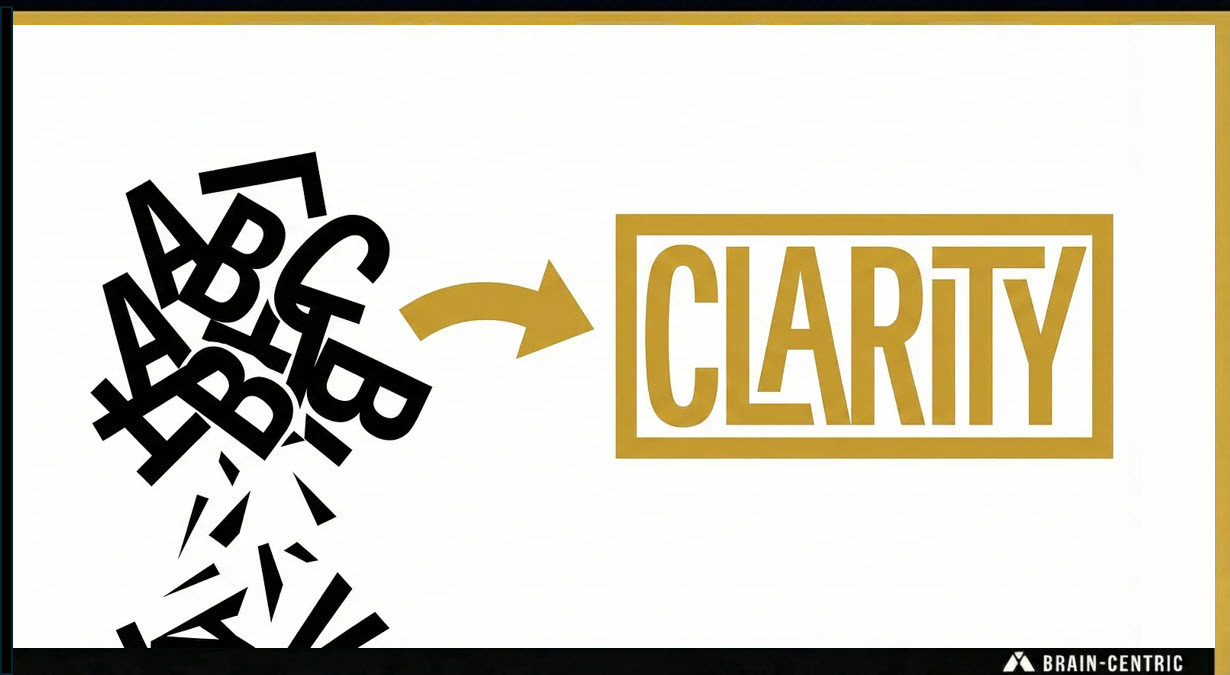
I'm about to show you something I normally only show clients.
It's called the Nested Egg. And while I'm using it here to build training for 500 managers, that's just one application.
The Nested Egg is a thinking system for any communication of consequence…when you're about to say or communicate something to someone, and you've got a goal in mind for doing so. A pitch to the board. A sales presentation. A change initiative no one asked for. A strategy rollout that can't afford confusion. A difficult conversation you've been avoiding. It has nothing to do with AI, and has everything to do with Premium Thinking.
It also works on yourself.
That decision you've been circling for months. The career pivot you can't quite articulate. The thing you know you need to do but can't seem to organize into action. The chaos isn't always external. Sometimes the pile of competing priorities is inside your own head, and no one's going to facilitate that session but you.
The Nested Egg tames chaos. External or internal. Corporate or personal. It sequences thinking in the order the brain can process it. And it only works when you feel safe enough to actually think…safe enough to be honest about what you see, to let ideas get moved or merged or cut without feeling diminished.
By the end of this article, you'll understand exactly how it works. But understanding isn't the same as doing. So I'm making an offer…
If you communicate anything of consequence - to a room, team, prospect, or to yourself - sign up here. I'm hosting a free one-hour webinar in February where I'll teach you how to facilitate this process. Everyone who attends gets access to our online Nested Egg builder/application and the supporting materials we use with clients, including a one-sheet quick reference guide. There will be no selling or upselling. No catch. Just a methodology that works and a room full of people who want to use it.
Now let me show you what this looks like in practice with an engagement involving a post-acquisition Fortune 500 company in a headline-grabbing growth and reimagining phase.
The call lasted nineteen minutes.
She didn't ask me to pitch. Didn't want a capabilities deck. Didn't schedule a "discovery session" with seventeen stakeholders and a shared Google Doc full of competing priorities.
She said: "I need you to optimize conversations across 500 managers. Every branch. Every division. Every worker type. Psychological safety and ROI. Build it and facilitate every session yourself. Five to seven weeks."
Then she paused.
"Can you do it?"
Here's what you need to understand about this client: she's not like the others.
Five years ago, she was a mid-level L&D professional who enrolled in my Brain-centric Instructional Design certification during COVID. She learned the methodology. Applied it. Watched her programs land differently than anything else in the organization, delivering the metric every time.
She got promoted. Then again. She built a department. Certified her entire team. Started calling me for projects…develop this, facilitate that, speak at this conference.
She didn't call me this time because she was shopping for training. She called because she understood, at a cellular level, what Brain-centric design actually does. And she had a problem that required exactly that.
The problem: the most non-AI activity in her company - conversations between managers and their people - was inconsistent, anxiety-producing, and leaking value at every location. Hundreds of branches across North America, each one running on the same hope-based system: managers winging it in many cases, avoiding the hard talks, defaulting to whatever worked (or didn't) last time.
But this wasn't about fixing performance reviews. That's too small.
This was about elevating leadership and staff across the entire enterprise through communication that produces action. Intrinsic ownership. Results that compound because people aren't just complying…they're thinking. They're building. They're bringing discretionary effort because someone finally talked to them like they mattered.
The Mandate: Structure those conversations for Premium Thinking. Every worker type. Every situation. Make the human interaction the competitive advantage, not the liability.
The Constraint: Five to six week window to deliver it all. Conclude by March 1st. Every manager trained. Me and their top designer facilitating every session.
She'd already done the math. She knew where the value was hiding. She just needed someone who could build the system to unlock it.
That someone was me.
The difference here is the most clients typically come with a pile of content and a vague hope. They want "leadership development" or "communication skills" or "something about coaching." They have slides from 2014. They have a VP who once read a book about emotional intelligence and has a lot of pull in the decision. They have opinions dressed up as requirements.
This wasn't that.
This was a client who already understood the architecture. Who knew that information without structure is noise. Who'd seen, firsthand, what happens when you design to the metric and keep it cognitive instead of designing to the agenda and leaders who want to toss title weight across the room.
She didn't need convincing. She needed execution.
But even execution requires engineering. And that's where the Nested Egg comes in.
The Nested Egg isn't a template I hand to clients. It's a guided process I facilitate with their stakeholders…a way of making thinking visible so it can be examined, moved, refined.
Picture a room. Whiteboard covered in sticky notes. Stakeholders from different divisions, each one carrying assumptions about what this training needs to be. The VP of Operations has ideas. HR has requirements. Regional directors have priorities shaped by problems I haven't seen yet.
All of it goes up on the wall. Visible. Tangible. A mess, at first, because that's what unexamined thinking looks like.
Then we start asking questions.
What's the metric? Not "what do you hope happens." The thing that changes. The shift you can see and measure.
For this engagement, here's where we landed:
Right now, managers are carrying every plan themselves. They're stressed. Overloaded. Running from person to person, checking in, following up, wondering why nothing sticks. The plan lives in the manager's head - or worse, in a spreadsheet no one opens - and the employee shows up each day waiting to be told what matters.
The metric was a shift from that to this: individual and team-owned plans with structured accountability the team member constructed themselves. With the manager, not from the manager. Support structures the employee identified. Goals that were theirs. Timelines they agreed to in a conversation that could happen in a conference room or on a stroll through the warehouse.
That's not a number on a dashboard. That's a fundamental change in how work gets done. The manager stops being the bottleneck. The employee stops being a passenger. And the branch starts running on ownership instead of oversight.
What's the Big Idea? This is the north star. The single concept that, if every manager truly understood it, would make everything else click into place.
We don't rush this. Stakeholders propose. Debate. Refine. Concepts that seemed essential at 10am get absorbed into something simpler by noon. Ideas that no one articulated at the start emerge from the collision of perspectives.
For 500 Mondays, the Big Idea crystallized as this: The way you start a conversation determines everything that follows.
Ten words. True at the neurological level. Actionable at the behavioral level. And directly tied to the metric because when managers start differently, employees build the plan instead of receiving it. Ownership transfers in the first sixty seconds or it doesn't transfer at all.
What are the Scaffolding Thoughts? These are the two things someone must thoroughly understand to grasp the Big Idea. Not five things. Not twelve. Two…because the brain can hold two in working memory while reaching for a third.
This is where the room gets dynamic. Sticky notes move. Clusters form and dissolve. Someone says something that reframes everything, and we reorganize in real time, in a psychologically safe space where we can say what we want to get to where we need to without catering thoughts, fawning, or corporate BS.
For this training, the two Scaffolding Thoughts emerged as:
The framework for how to structure the conversations. A repeatable structure for conversations that transfer ownership…not a script, but a recipe. Something a manager can internalize and make their own, whether they're in a scheduled one-on-one or walking the warehouse floor. The framework is the system that replaces winging it.
The four worker types the recipe applies to. Underperforming. Complacent. High-performing. Goal-setting. The framework applies to all four - same bones, same sequence - but with subtle nuances that match each person's current mindset. The underperformer isn't in the same headspace as the high performer. The coaster needs a different door opened than the goal-setter. One framework, four applications. Miss the nuance and you're having the wrong conversation with the right structure.
By the end of the session, what started as a wall of scattered thinking has become a nested structure: Metric at the outside, Big Idea at the center, Scaffolding Thoughts holding them together.
Now we know what we're building.
Now comes the hard part…so much of our original thinking, what should be included, is about to hit the cutting room floor
Even with a sophisticated client, there's a pile. There's always a pile. A pile of thoughts, concepts, agendas and opinions that don't make it to the final product.
Stakeholders from other divisions. Regional priorities. Compliance language that legal wants included. A wellness initiative someone's been championing. Good ideas, mostly. Well-intentioned. Each one adding cognitive load that competes with the Big Idea.
So we take what remains on the wall - everything that didn't become the Big Idea or a Scaffolding Thought - and hold each piece up to the light. One question: Does this directly support one of the two Scaffolding Thoughts?
If yes, it stays. Gets sequenced in the order the brain can receive it…foundation to complexity, each concept preparing ground for the next, in the order of impact to that scaffolding thought, that supports the Big Idea that delivers that metric.
If no, it goes to the floor. Doesn't matter who sponsored it. Doesn't matter how reasonable it sounded in the meeting.
The wellness module? Floor.
The six-step feedback model from the previous vendor? Floor.
The "manager as coach" framework that I had had been developing for another project but fit here, sort of? We kept one piece, the part about asking instead of telling. The rest? Floor.
This is the part where trust matters. Even a client who knows the methodology has to watch things she cares about get cut. Has to believe, against instinct, that the training will be stronger for the absence.
She did.
Because she'd built enough Brain-centric programs to know: density isn't depth. More content doesn't mean more learning. It means more forgetting. What remains after the cuts is what actually transfers.
By the end of this Nested Egg process, we had:
A metric that redefines how work gets done, from manager-carried plans to employee-owned accountability
A Big Idea every stakeholder could articulate in ten words
Two Scaffolding Thoughts: the framework itself, and the four worker types it flexes to meet
A prioritized sequence of supporting concepts, ordered for how the brain actually learns and impact against or netric
A cutting room floor full of good ideas that didn't make the cut
And something harder to quantify: alignment. Every stakeholder in that room understood what we were building and why. No competing agendas. No silent disagreements waiting to surface in week three.
And still, not a single slide designed. This training didn't even have a clever name yet. Not one breakout session planned. Not a minute of facilitation scripted. Not even a name for the training…although we did have a working title we knew was going to change to something that, once articulated, would describe the entire experience and deliverable of the training. The title would be seven words or less, about what you can read and understand on a billboard as you drive 70 MPH down the freeway and need to understand the message to complete the next action (i.e. McDonald's logo + “ Next Exit”) GPS-simple.
With Brain-centric, Design comes last. Thinking comes first. Premium Thinking.
Next week, I'll show you what we built with all that thinking. The Challenge Wheel - the pedagogical framework that turns structure into experience. The thing that makes managers lean in instead of check out. We even unanimously agreed on a name that describes the benefit to the participants immediately and drives engagement…meta-marketing.
But this week, I wanted you to see the invisible work. The work that happens before the first slide. The work that most training skips entirely and wonders why nothing changes.
This client didn't skip it. She demanded it.
That's why she called me.
The Nested Egg works for enterprise training. It works for board presentations and change initiatives. It also works at 2am when you're staring at the ceiling wondering what you really want but have too many things wrestling to be a part of it…whatever it is.
If you've read this far and you're thinking I need this, DM me. Free webinar. Real methodology. No catch.
Next Monday: The Challenge Wheel…how to build learning experiences the brain craves using the output your Nested Egg delivered.
In the meantime: If you know someone who designs training, develops people who manage people, or wonders why most leadership development feels like elaborate theater, send them this. They'll want to follow along.
This is part of 500 Mondays, a real-time documentation of what happens when 500 managers learn a system for the conversations they've been dreading. Subscribe below if you're just joining.
'Density isn't depth. More content doesn't mean more learning. It means more forgetting.' This is the discipline I'm learning to practice, both in my work and in how I communicate it. The Nested Egg gives structure to what I've been doing but didn't have a language for it. I am always interested in your work, Rich. Thanks for making the invisible work visible.
“More content doesn't mean more learning. It means more forgetting.” - going on a Post-It note to be stuck on my computer monitor, thank you.