

CH10: Framing For Invisible Influence
Depending on how you look at it: The 'How To' of Guiding Perspective

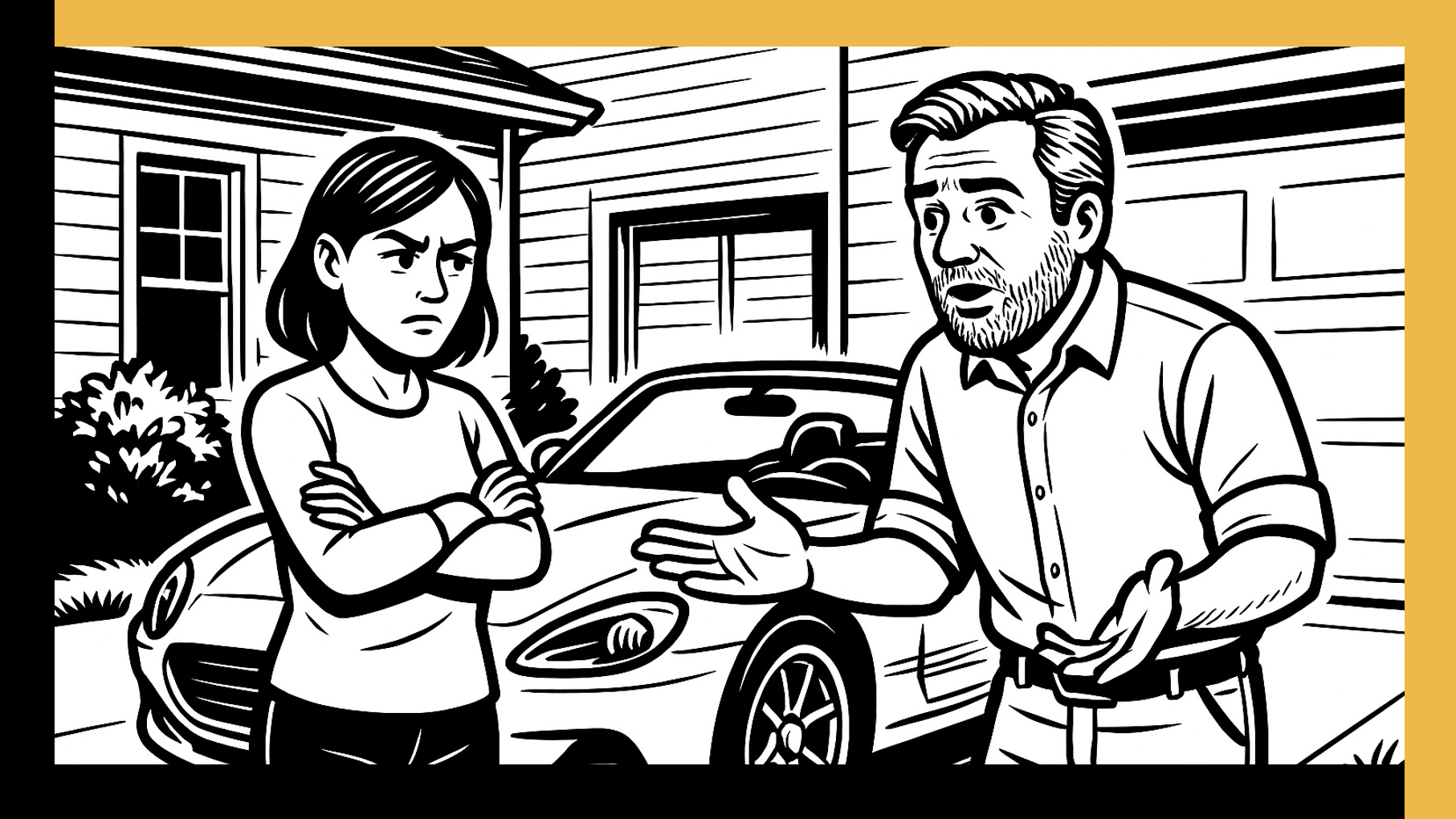
"I can't believe you bought that car without asking me," she said, arms crossed, staring at the gleaming red convertible in their driveway.
Lyle had been dreading this moment all day. "I know, I know. But listen…"
"We talked about saving for the house down payment. We agreed. And then you go and blow it on some midlife crisis mobile."
Lyle took a breath. He'd rehearsed this. "You're absolutely right to be upset. Depending on how you look at it, I just made the most irresponsible financial decision of our marriage."
Angela's anger flickered. "What do you mean, 'depending on how you look at it'?"
"Well," Lyle said carefully, "if you look at it as me spending our house money on a toy, then yeah, I'm an idiot."
"Exactly."
"But if you look at it as me buying the car your dad has been trying to sell for six months, the one he's been too proud to ask us to help with, then maybe I'm not such an idiot after all."
Angela's expression shifted. "Wait. This is Dad's car?"
"He called this morning. Said he found a buyer, but then the guy backed out. He was trying to sound casual, but I could hear it in his voice. He needs the money, Ang. And he needs it before the bank meeting on Friday."
The whole conversation changed in that instant.
Same car. Same driveway. Same couple.
Completely different reality.
Invisible Influence creates a thinking shift that restructures an entire relationship dynamic.
Angela experienced what cognitive scientists call a frame shift. Her brain was processing through the lens of "reckless spending" until Lyle offered a different lens: "family loyalty." Same facts. Different frame. Different outcome.
Lyle didn't argue with Angela's initial frame. He didn't say she was wrong. He acknowledged her perspective, then gently introduced an alternative view that her brain could adopt without losing face.
That's the invisible power you use every single day without realizing it.
Every time you say "depending on how you look at it," you're performing cognitive engineering. You're teaching the brain that perspective is optional. That multiple realities can coexist. That shifting viewpoints doesn't require abandoning identity.
You already frame by shifting viewpoints without realizing how strong this phrasing, placed strategically, is…
"It's all about perspective,"
"You could see it that way, or..."
"From where I'm sitting..."
"On the flip side..."
"Then again..."
These phrases all perform the same cognitive function; they signal that multiple viewpoints exist without invalidating the current one. People drop these into conversations instinctively because they soften potential disagreement while opening space for frame shifts.
You hear them everywhere…
"It's all about perspective, but I think we dodged a bullet."
"You could see it that way, or you could see it as a chance to start fresh."
"From where I'm sitting, this looks like an opportunity."
"On the flip side, maybe this delay actually saved us from rushing."
"Then again, what if this is exactly what we needed?"
Each one is invisible framing in action, everyday cognitive engineering that most people deploy without realizing they're restructuring how others think.
Most people stumble into this accidentally. You're about to learn how to engineer it deliberately.
Because you can't control how people think.
You can control where they think.
That's invisible framing.
Let's break something early…
You're not steering their thoughts.
You're not implanting suggestions.
You're not "nudging" like a behavioral economist playing with lab rats.
You are preparing space. Mental processing space. Space to think about what you’re about to say/communicate/present so they can noodle on it and come up with their right answer. Not yours.
Space creates direction. Direction guides attention. Attention opens influence.
This is invisible framing.
Imagine walking into an art gallery.
The walls are clean. The lighting is focused. One painting sits on each wall. The room is designed so your eyes fall exactly where the curator wants.
The gallery doesn't force you to look.
It makes looking natural.
That's framing, too.
Far too often, people in business walk into conversations like flea markets…tables covered with random items, fighting for attention. Row after row, table of this, table of that. Each fact, each argument, each feature competes for cognitive space…space for them to think about what you are about to communicate.
Invisible influence works like the gallery.
One wall. One painting. No noise.
The brain relaxes and follows the frame.
A frame is nothing more than:
The question you allow them to keep asking themselves while you speak…
That question shapes how they evaluate everything that follows.
If you frame a problem as cost, they evaluate cost.
If you frame it as safety, they evaluate safety.
If you frame it as time, they evaluate time.
Historically, people are very poor at framing because they frame for themselves, not for the brain they're influencing. You’re not trying to influence yourself; you want to influence them.
Stop making this about you.
Your communication isn't a performance where you're the star. It's not a showcase for your brilliance. It's not therapy for your insecurities or a stage for your ego. The moment you start caring more about looking smart than being understood, you've lost. The moment you prioritize feeling impressive over creating clarity, your influence dies. This work, all of it, is about their brain, their adoption, their success. Not yours. Get comfortable with being invisible. Get comfortable with them taking credit. Get comfortable with your ideas succeeding while you disappear into the background. Because the professionals who master invisible influence don't need applause. They get results.
Stop thinking: What do I want to say?
Start thinking: What do I want their brain searching for while I speak?
The first creates friction. The second creates cognitive glide. The most powerful frames aren't even declared. They're implied.
You don't say…
"Let's make this about safety."
"Let's focus on reputation."
You drop a line early that loads the frame quietly. Like this…
"The companies that weathered the last downturn weren't necessarily the most profitable. They were the most resilient."
Without announcing it, you've framed every idea that follows inside resilience. They listen differently. They process differently. They adopt differently.
Once a frame is loaded, the brain seeks consistency. The frame becomes the lens through which every subsequent point is judged.
If your frame is resilience, then…
Your solution becomes protective.
Your value becomes stability.
Your plan becomes assurance.
The brain evaluates your ideas relative to the frame it's holding. This is why you guide, not direct.
When you direct, objections arise when people process your idea through a competing frame. It’s that simple.
Here’s someone directing…
They present their software's feature set.
Their audience evaluates through a cost frame: "Is this feature worth the money?"
They lose, not because their feature lacks value, but because they used the wrong lens.
If they had preloaded a time frame…
"The companies seeing the fastest returns reduce manual reports by 40 hours a month."
Their audience now evaluates the same feature through reclaimed time, not line-item cost. Objection risk drops. Adoption odds rise.
The Frame Formula
Let's give you a structure to apply immediately:
Identify Their Primary Fear or Goal
Stability?
Profit?
Reputation?
Control?
Effort?
Speed?
Select the Dominant Frame
One frame only
Drop the Frame Early Without Announcing It
Use story, data point, or casual observation.
Speak Into the Frame Consistently
Let every point feed that lens.
Anchor Their Adoption to Frame Satisfaction
"That's why your team stays resilient."
"That's how you eliminate surprise expenses."
"That's how your reputation remains untouchable."
The brain feels consistency. Consistency breeds confidence. Confidence creates adoption. Let me demonstrate:
Your teenager asks to take the car.
You want them to drive safely.
Instead of giving rules, you load the frame early:
"I just found out most accidents don't happen because of reckless driving. They happen when people relax on familiar roads."
That line quietly frames safety as vigilance, not fear.
Now, when you say:
"Call me before you leave and when you get there."
The request feels part of vigilance, not control.
Adoption follows.
If your concern is AI, AI will increasingly suggest talking points. AI will increasingly optimize scripts.
AI cannot frame.
It cannot feel which lens the audience’s brain is holding. It cannot sense emotional weight. It cannot adjust sequencing to stabilize frames during conversation.
Your mastery of invisible framing becomes your insulation against AI commoditizing your knowledge.
Where AI talks, you guide. Where AI informs, you adopt.
That's where human advantage lives.
If maximizing your human advantage over machines and others sounds appealing to you, you must live by the 'Neural Rule' of Invisible Influence:
Someone always frames first.
Framing will happen. Now, it's whether you'll control it or accept someone else's frame by default. When you own the frame, you own the adoption. Always.
To illustrate the point, picture two contractors standing in front of the same plot of land. Both are bidding for the client's trust.
But here's what the client doesn't realize: they've already framed this decision before either contractor opens their mouth. In their mind, this is about "choosing the most qualified expert to build my house."
That frame sits there, invisible but powerful, waiting for someone to either reinforce it or replace it.
The first contractor accepts that frame completely.
He rolls out blueprints. He describes the materials. He explains load-bearing walls, soil compaction ratios, the properties of rebar under strain.
He talks, he informs, he references past jobs, proving his knowledge and expertise.
He's playing perfectly inside the client's existing frame: "I am the most qualified expert."
The client listens with interest. The information is accurate. The expertise is evident. But "that was a lot of information with a lot of examples about a lot of stuff…". The client feels the weight of ensuring the expert's knowledge translates into what they wanted done in the first place.
The brain works harder. The negotiator tightens.
Cognitive load rises.
The second contractor steps forward. He doesn't accept the client's frame.
Instead, he reframes quickly, quietly, and completely.
He points to the empty lot and says:
"Before we even break ground, let's start at your back porch you were saying you're excited about. That's where you'll have your coffee every morning while the sun rises. You'll hear the birds right over there in that line of trees we'll preserve with this great idea we came up with."
The client's brain locks in.
Visual. Emotional. Concrete.
Without announcing it, the contractor has loaded a new frame: this isn't about choosing the most qualified expert - it's about creating your perfect life experience.
The decision shifts from "who knows more about construction" to "who understands what I really want."
From that moment forward:
When he describes insulation, it's about comfort.
When he discusses drainage, it's about protecting that peaceful morning.
When he proposes layout changes, it's about sightlines to the sunrise.
The frame holds.
The brain relaxes into ownership.
The client sees not a house, but their house.
The sale was won the moment he reframed.
This is invisible framing.
The first contractor reinforced the client's existing frame and lost.
The second contractor reframed first and won.
Both were technically right. Only one understood that someone always frames first, and if you don't do it deliberately, you're stuck with whatever frame already exists.
Now, notice what I just did to your brain.
You've already seen the cognitive glide path. You've already learned about prediction error. You've already built sequencing and stabilization.
But this time, you saw it in a house.
Your brain loves repetition with novelty.
Same principle. New skin. Same structure. New context.
This is how memory forms.
When you experience the same idea from multiple perspectives and novel angles, your brain doesn't fatigue. It strengthens the frame. In this case, the frame I want you to understand is what a frame is and how it's used.
This is also the exact mechanism you will now begin using.
When you influence, you don't repeat your argument. You repeat your frame. You bring novelty to familiar ground. You lead them back to the model through fresh doorways.
Story here.
Metaphor there.
Case study here.
Personal anecdote there.
Their brain feels mastery forming.
Adoption grows roots.
Now you see the house we're building together.
You have:
The Glide Path — how to enter the brain's conversation.
The Negotiator — the gatekeeper deciding what enters.
The Prediction Error — how to trigger curiosity, not resistance.
The Resolution Model — how to close loops with adoption, not pressure.
The Strategic Surprise — how to keep their mind open and processing.
The Cognitive Engineering — how to lead without forcing.
The Invisible Frame — how to control where their mind travels while you speak.
These are rooms inside the same house, not isolated tricks or hacks. You're learning how to live inside influence, not visit it.
The Invisible Framing Field Kit
Three Scripts for Any Meeting
You've seen how framing works. You understand why it matters. Now let's make it practical.
These three scripts work whether you're talking to a colleague about project priorities, a friend about weekend plans, or a neighbor about the fence line. The beauty of invisible framing is that it scales from coffee conversations to boardroom negotiations using the same cognitive architecture.
Script 1: Acknowledging the Meeting
When you need to establish safety and alignment before diving in
The Frame: "We're on the same side of this"
Step 1: Name the shared reality "I know we're both feeling the pressure on this timeline."
Step 2: Frame the collaboration "What I'm hoping we can figure out together is how to get this done without either of us losing sleep."
Step 3: Invite partnership "Depending on how we approach it, this could either be the project that burns us out or the one that shows everyone how good we are at solving problems together."
Why this works:
Eliminates defensive positioning before it starts
Frames the conversation as collaborative problem-solving
Creates psychological safety through shared ownership
Uses "depending on how we approach it" to signal multiple outcomes are possible
Real conversation example: "Hey Sarah, I know we're both staring at this deadline thinking 'how the hell are we going to pull this off?' What I'm hoping we can figure out together is how to tackle this without either of us working weekends again. Depending on how we approach it, this could either be the project that finally breaks us or the one that proves we're the team that gets impossible stuff done."
Script 2: Beginning the Meeting
When you need to frame the entire conversation's direction
The Frame: "Here's what success looks like for both of us"
Step 1: Acknowledge what they're probably thinking "You're probably wondering if this is going to be another one of those meetings where we talk in circles."
Step 2: Reframe the purpose "What I'd like us to walk away with is a plan we both actually want to execute."
Step 3: Set the cognitive container "The way I see it, we've got two paths: we can spend an hour debating details and leave here frustrated, or we can spend twenty minutes aligning on what matters most and leave here energized."
Why this works:
Surfaces their likely prediction and defuses it
Reframes the meeting from "obligation" to "mutual benefit"
Creates time pressure that encourages focus
Offers binary choice that feels empowering
Real conversation example: "Okay, I'm guessing you're sitting here thinking 'please don't let this be another meeting where we rehash the same stuff for an hour.' What I'd like us to walk away with is a plan we both feel good about executing. The way I see it, we've got two choices: we can spend the next hour getting lost in the weeds, or we can spend twenty minutes getting clear on what actually needs to happen. Which sounds better to you?"
Script 3: Pivoting in Meeting
When you need to redirect without creating resistance
The Frame: "Let's look at this from a different angle"
Step 1: Validate current direction "That's definitely one way to think about it, and I can see why that makes sense."
Step 2: Introduce the pivot signal "Then again, what if we're looking at this backwards?"
Step 3: Offer the reframe "Instead of asking 'how do we make this work,' what if we asked 'what would need to be true for this to be easy?'"
Why this works:
Validates their thinking before redirecting
"Then again" signals frame shift without invalidation
Reframes from problem-focused to solution-focused
Questions are less threatening than statements
Real conversation example: "I hear you saying the budget is the main issue, and yeah, that definitely makes sense given what we're working with. Then again, what if we're thinking about this backwards? Instead of asking 'how do we stretch this budget to cover everything,' what if we asked 'what would need to be true for us to deliver something amazing within this budget?'"
The Universal Framing Phrases
Keep these in your back pocket for any situation
Frame Shifters:
"Depending on how you look at it..."
"Then again..."
"What if we're thinking about this backwards?"
"From where I'm sitting..."
"Here's another way to think about it..."
Collaboration Frames:
"What I'm hoping we can figure out together is..."
"The way I see it, we've got two paths..."
"What would need to be true for both of us to win here?"
Safety Frames:
"That makes complete sense, and..."
"I can see why you'd think that..."
"You're probably wondering..."
Quick Reference: The 5-Second Frame Check
Before you speak in any meeting, ask yourself:
What frame are they probably holding right now?
What frame would serve us both better?
How can I acknowledge theirs before introducing mine?
Remember: You're not manipulating. You're preparing space for both of you to think more clearly.
Practice Assignment
This week, try each script once:
Script 1 before a challenging conversation
Script 2 at the start of your next meeting
Script 3 when you need to redirect a discussion
Notice how the other person responds. Notice how you feel. Notice what becomes possible when you frame first.
That's invisible framing in action.
Invisible framing isn't a technique you learn. It's a skill you already have.
You've been doing it your entire life without realizing it. Every time you said "depending on how you look at it" or "then again" or "what if we tried this instead," you were restructuring someone's cognitive architecture.
The only difference now is that you see it. Now you understand it.
You understand that framing isn't manipulation, it's preparation and respect for the audience's thinking, and ensuring they are ready for yours. You're creating space for better thinking. You're not controlling thoughts.
When do you use invisible framing? Always. Because every conversation already has a frame. If you don't choose it deliberately, someone else will choose it accidentally. Or worse, the frame will default to whatever cognitive baggage people bring.
The beauty is how natural this feels. You're not performing. You're not scripting. You're simply being more intentional about something you already do instinctively.
Now comes the fun part.
Start watching for frames everywhere. In conversations at lunch. In the way your kids ask for privileges. In how the barista frames the daily special. In how your boss opens staff meetings.
You'll begin to notice that people spend most of their day reacting to frames that other people set. The person who frames first doesn't have to react; they get to guide.
This awareness doesn't fade. Once framing becomes visible to you, it stays visible.
And that's when you realize you've been holding this power all along.
You just needed to know you had it.