

CH13: The Language of Cognitive Safety
How Words Create Space for Thinking

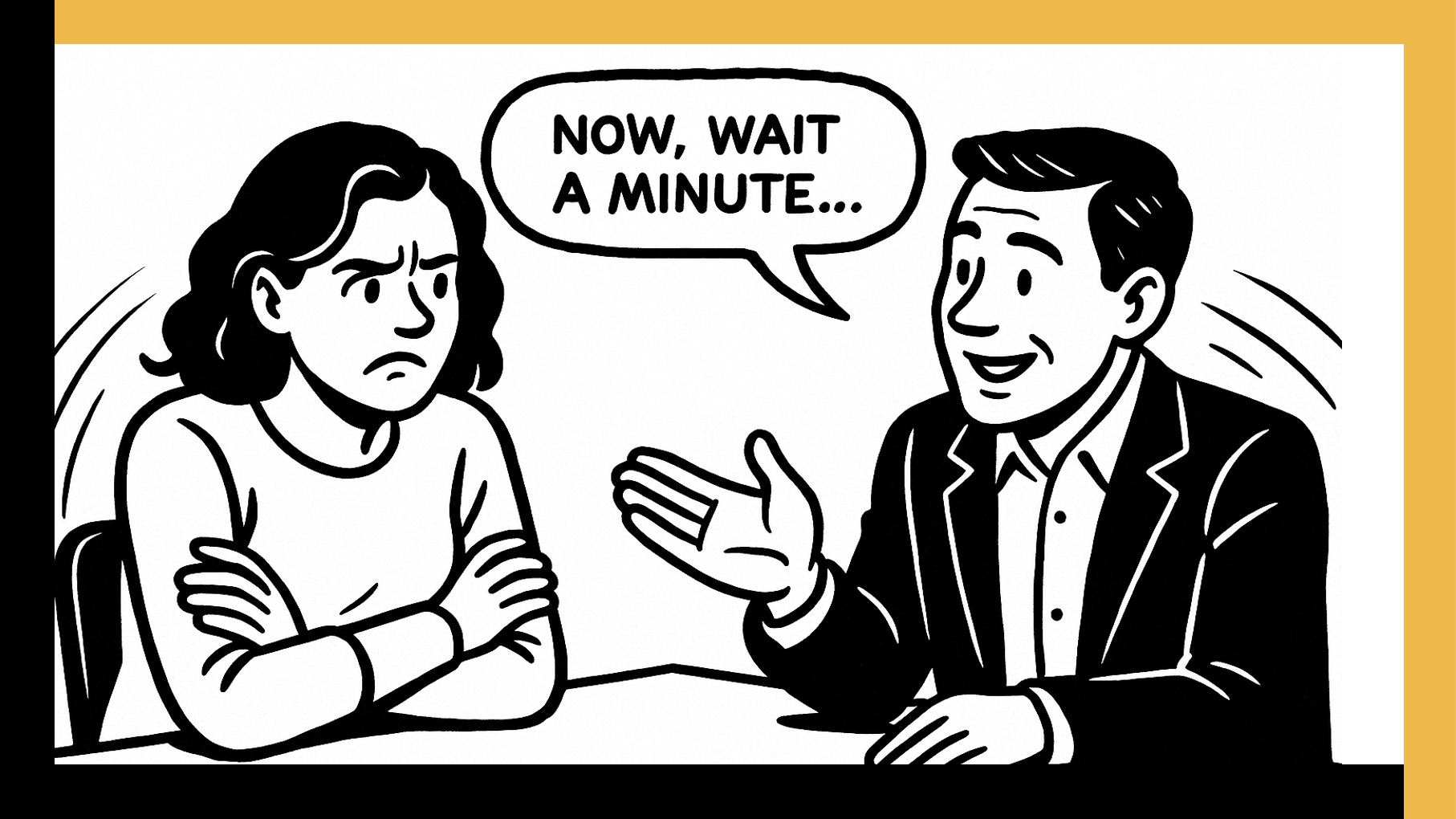
There's something almost mystical about the moment a conversation shifts.
You've felt it. One second, someone's defenses are up, their words careful, their posture guarded. The next, they're leaning forward, speaking freely, sharing thoughts they hadn't planned to reveal. Nothing dramatic happened. No grand gesture. No brilliant argument.
Just a subtle change in how the air felt between you.
That is the result of something most people never notice but every brain constantly monitors: whether the space feels safe enough to think.
Not safe from physical harm. Safe from something far more primal…the risk of being wrong, foolish, or exposed.
The brain has an ancient radar system, older than language itself, that scans every interaction for cognitive threat. Long before it evaluates your logic, it asks a more fundamental question: Can I afford to lower my guard here?
And that three-pound negotiator sitting inside everyone's noggin’? Its primary job isn't actually thinking. It's threat detection. It's asking whether this conversation feels safe enough to let new ideas in.
Most people unknowingly trip that alarm system with their very first words.
Picture walking into a jewelry store. The moment you enter, the sales associate approaches with polished enthusiasm. "What brings you in today? Looking for something special? Anniversary? Birthday?" The questions come quickly, each one requiring you to reveal more about your intentions, your budget, your relationships.
Your brain's negotiator immediately calculates: This person wants something from me. I need to protect my position.
The walls go up before any jewelry is shown.
Now picture walking into a different store. The associate looks up, smiles warmly, and says, "Take your time looking around. I'm here if you have questions, but no pressure at all." Then they return to their work, giving you space.
The negotiator relaxes. I'm in control here. I can explore without commitment.
The same jewelry. The same potential transaction. Entirely different cognitive climates.
This is the invisible architecture of safety that flows beneath every human interaction.
Consider how children learn to trust adults. Not through grand declarations of safety, but through small, consistent signals. The adult who kneels to the child's eye level. Who speaks softly rather than loudly. Who waits for answers rather than rushing to fill silence. Who says "That's a good question" instead of "Don't worry about that."
Each gesture whispers to the child's developing mind: You are safe to be curious here.
The same dynamics govern every professional conversation you'll ever have. Every single one.
When you say, "This solution will definitely solve your problem," the negotiator hears pressure and absolutes. It starts building counterarguments.
When you say, "This approach has worked well for others in similar situations," the negotiator hears possibility and choice. It starts exploring fit.
The difference isn't in the confidence of your solution. It's in the cognitive space you create around that solution.
Let me tell you about an upper cervical chiropractor I worked with named Dr. Boyd.
He had a problem that strikes at the heart of professional influence. Like that executive at the dinner party who kept glazing over during pitch after pitch, Dr. Boyd was losing patients not because his treatment didn't work, but because his explanations overwhelmed their ability to process.
Patients would come to him after months or years of chronic pain, desperate for relief. But the moment he explained upper cervical care, how a tiny misalignment at the top of the spine could affect their entire nervous system, their eyes would glaze over.
They'd be polite most of the time, though whatever he was saying was hard to understand. Schedule an appointment, then often cancel before returning.
The issue wasn't his expertise. Dr. Boyd was brilliant. But he was drowning his patients in perfectly accurate details that their exhausted, pain-addled brains simply couldn't carry. Like loading cargo onto a boat until it starts to sink, he was stacking information faster than their minds could process it, forcing that vigilant negotiator to start discarding pieces just to stay afloat.
When I first observed his patient consultations, I watched as cognitive safety collapsed in that exact moment. He'd show spine models, point to X-rays, explain vertebral subluxations, and neurological interference patterns. Each technical term was accurate. Each concept was important.
And each one pushed the patient's negotiator further into protection mode.
Let's pause here and break the fourth wall for a moment.
You and I have been walking through this house of influence together for more than a dozen chapters now. You've seen how prediction error opens doors, how frames guide thinking without directing it, how quiet authority builds trust. You understand that resistance isn't about logic; it's about the brain protecting itself from overwhelm.
But here's what I want you to notice about Dr. Boyd's story: he wasn't failing because he lacked sophisticated techniques. He had deep knowledge. He understood spinal mechanics better than almost anyone.
His problem was simpler and more fundamental. Before he could frame anything, before he could create the controlled surprise that opens learning, before he could guide anyone toward resolution, he had to create the one thing that makes all influence possible: safety.
Watch what happened when we shifted his approach.
Instead of starting with anatomy, Dr. Boyd learned to start with recognition.
"I know you've probably tried everything," he'd say to new patients. "Physical therapy, medication, massage, maybe other chiropractors. And you're sitting here wondering if this is just going to be more of the same."
And there it is…the field stabilizes. But notice how he's doing it. He's not just lowering defenses. He's creating cognitive safety by acknowledging their prediction without challenging it. The negotiator recognizes: This person understands my world. I'm not being judged for my past failures.
The patient's shoulders would drop slightly. He sees me.
"Most people don't realize that the very top of your spine, right here behind your ears, is different from everywhere else. It doesn't have the same locking mechanisms as the rest of your vertebrae. So when it shifts even slightly, it affects how your entire nervous system communicates."
He'd pause, watching their face. Then came the magic.
"Think of it like having a loose connection in your home's main electrical panel. The problem isn't in your bedroom lights or your kitchen outlets. But because the main connection is unstable, random things throughout your house stop working properly."
Do you see what just happened? He took a complex spinal concept and nestled it inside something they already understood completely. No technical overwhelm. No cognitive strain. Just a clear, familiar frame that lets their brain relax and process. The mind suddenly has a comfortable place to put this new information right next to everything it already knows about household electrical problems.
The patient would nod. Not politely, but with recognition. I understand this.
"What I do is very specific. I don't crack or twist your spine. I use precise, gentle corrections to help that top vertebra settle back into proper position. Your nervous system does the rest of the healing."
And there's the resolution…but notice how he delivered it. He didn't position himself as the miracle worker. Instead of building his own authority by showcasing expertise, he stepped back from the hero role and let the patient's own body be the star.
Now let me show you exactly how Dr. Boyd's transformation maps onto the Glide Path we've been building throughout this book. This is where cognitive safety reveals itself not as a separate technique, but as the way you execute each stage without triggering the brain's defense systems.
STAGE 1: STABILIZE THE FIELD (with cognitive safety)

Dr. Boyd's words: "I know you've probably tried everything..."

What this accomplishes:
- Acknowledges their current reality without judgment
- Validates their past efforts (no failure shaming)
- Signals understanding, not superiority
- Creates permission to feel skeptical
- The negotiator reads: "This person sees my struggle"
STAGE 2: SURFACE THE PREDICTION (with acknowledgment)
Dr. Boyd's words: "And you're sitting here wondering if this is just going to be more of the same."
What this accomplishes:
- Names their exact internal dialogue
- Shows he understands their protective stance
- Gives voice to their unspoken concern
- Removes pressure to pretend optimism
- The negotiator reads: "I don't have to hide my doubt"STAGE 3: TRIGGER PREDICTION ERROR (with familiar frames)
Dr. Boyd's words: "Most people don't realize that the very top of your spine is different... Think of it like a loose electrical connection..."
What this accomplishes:
- Breaks their current model gently
- Provides immediate frame for processing
- Uses familiar reference (electrical panels)
- Keeps cognitive load manageable
- The negotiator reads: "I can understand this new information"STAGE 4: GUIDE TO RESOLUTION (with empowerment)
Dr. Boyd's words: "Your nervous system does the rest of the healing."
What this accomplishes:
- Positions patient as capable, not dependent
- Removes ego threat from practitioner expertise
- Creates ownership over outcomes
- Maintains patient's sense of control
- The negotiator reads: "I remain empowered in this process"The revelation isn't a new framework; it's that cognitive safety is woven into how you execute each Glide Path stage. The sequence stays the same. The protective language keeps the negotiator calm throughout.
But now we need to go deeper. Because while the Glide Path gives you the structure, and cognitive safety gives you the approach, there's one more layer that determines whether influence happens or fails: the actual words you choose.
Most professionals think about communication in terms of messages, concepts, and arguments. They worry about what to say, not how to say it. But here's what years of studying cognitive influence has taught me: the brain doesn't process messages. It processes individual words, one at a time, each carrying its own weight, its own emotional charge, its own threat or safety signal.
Words are the building materials of influence. And just like you wouldn't build a house with the wrong materials, you can't build cognitive safety with the wrong words.
Let me show you what I mean.
Consider these two ways of saying essentially the same thing:
Version A: "We need to optimize your operational infrastructure to maximize efficiency and minimize redundancies."
Version B: "We can help your team spend less time on busy work and more time on what actually matters."
Both sentences point toward the same outcome. But they create entirely different experiences in the listener's brain.
Version A is loaded with what I call "heavy words" - optimize, operational infrastructure, maximize, minimize, and redundancies. These are words that signal complexity, effort, and cognitive work ahead. The brain hears them and immediately starts calculating: How much energy will I need to understand this? How much change will this require?
Version B uses "light words" - help, team, less time, more time, matters. These are words that feel immediately accessible. The brain processes them effortlessly, focusing on outcomes rather than complexity.
Same concept. Different cognitive load. Completely different reception.
Here's a simple test I use for every important conversation: Do my words illuminate understanding, or do they demonstrate my intelligence?
Illuminating words create light. They make complex things clear, foreign things familiar, overwhelming things manageable. They serve the listener's brain.
Demonstrating words create distance. They showcase expertise, establish hierarchies, and often overwhelm the very people you're trying to reach. They serve the speaker's ego.
Let's see this in action…
Heavy/Demonstrating: "Our proprietary methodology leverages cognitive behavioral frameworks to facilitate transformational outcomes."
Light/Illuminating: "We've found a way to help people change patterns that aren't working for them anymore."
Heavy/Demonstrating: "This solution provides unprecedented visibility into your data architecture's performance metrics."
Light/Illuminating: "You'll finally see exactly where your information gets stuck and why."
Heavy/Demonstrating: "We utilize cutting-edge pedagogical approaches to enhance knowledge acquisition and retention."
Light/Illuminating: "We help people learn things in ways that actually stick."
Feel the difference? The heavy versions sound impressive in a conference room. The light versions actually move people to action.
After years of observing what creates cognitive safety and what destroys it, I've noticed that certain words consistently open minds while others consistently close them. Here's your practical guide:
Words That Create Safety:
Might instead of will
"This might be exactly what you need" vs. "This will solve your problem"
Could instead of should
"You could consider this approach" vs. "You should adopt this strategy"
Often instead of always
"This often works well" vs. "This always delivers results"
Some people instead of everyone
"Some people find this helpful" vs. "Everyone benefits from this"
In my experience instead of studies show
"In my experience, this tends to work" vs. "Studies conclusively prove this works"
Words That Destroy Safety:
Obviously
implies the listener should already know this
Clearly
suggests they're missing something evident
Simply
minimizes their sense of complexity
Just
makes their concerns feel trivial
Actually
signals they were wrong about something
Definitely
removes their sense of choice
Absolutely
eliminates room for their own judgment
Some words naturally grant permission for the brain to think freely. Others naturally restrict that permission. The difference is enormous.
Permission words
might, could, perhaps, sometimes, often, tends to, in some cases, many people find
Restriction words
must, should, always, never, obviously, clearly, definitely, absolutely
Dr. Boyd's transformation happened largely because he shifted from restriction language to permission language:
Before: "Your spine is definitely misaligned and this will absolutely fix it."
After: "There might be a misalignment that could be affecting how your nervous system communicates."
Same information. Different permission level. Completely different reception.
But here's where it gets even more sophisticated. The same word can illuminate for one audience and demonstrate intelligence to another. Cognitive safety requires that you match not only the complexity level of your audience but also their cultural context.
If you're speaking to engineers, words like "optimize" and "efficiency" might feel comfortable and precise. If you're speaking to artists, those same words might feel cold and reductive.
If you're speaking to executives, "strategic implementation" might signal competence. If you're speaking to front-line employees, it might signal disconnection from their daily reality.
The test isn't whether your words are right or wrong. The test is whether they illuminate understanding for the specific brain you're trying to reach.
Let me show you how Dr. Boyd's transformation went far deeper than sentence structure. He completely rebuilt his vocabulary to match his patients' world.
Old vocabulary (demonstrating expertise):
"Vertebral subluxation" → New vocabulary (illuminating understanding): "When that top bone shifts position"
"Neurological interference" → "Communication problems between your brain and body"
"Proprioceptive dysfunction" → "Your body loses track of where things are"
"Orthogonal correction" → "Gentle, precise adjustment"
"Homeostatic restoration" → "Your system finds its natural balance again"
Same concepts. Entirely different cognitive load. The technical terms served his expertise. The accessible terms served their understanding.
Think of this like material science. An architect might know that steel has a tensile strength of 400 megapascals, but when explaining to a client why steel beams are better than wood, they'll say "steel doesn't bend under weight the way wood does."
Same knowledge. Different materials for different audiences.
Your expertise gives you the knowledge. Your word choice gives that knowledge a form the listener's brain can actually use.
Most professionals get this backward. They use their expert vocabulary to sound credible, not realizing that credibility comes from being understood, not from sounding smart.
Dr. Boyd discovered that patients trusted him more when he spoke in their language, not his. Because when people understand you clearly, they feel smarter. When they feel smarter, they trust you more. When they trust you more, they adopt your recommendations.
Here's what makes this even more powerful: these word choices compound throughout the conversation. Each light, illuminating word makes the next one land more easily. Each heavy, demonstrating word makes the brain work harder to process what follows.
It's like climbing a mountain. You can choose a path with gentle switchbacks, or you can choose a path that goes straight up the cliff face. You'll reach the same summit either way, but only one path allows the person following you to arrive with energy to spare.
And here's what you're experiencing right now, as you read this: you're living inside invisible influence. Every word choice in this book has been calibrated for cognitive safety. Every sentence has been tested for illumination over demonstration. Every concept has been nested inside frames you can carry.
You're not just learning about word choice. You're experiencing how the right words create the space where complex ideas feel accessible, where new frameworks feel familiar, where changing your mind feels like growing stronger rather than admitting error.
That's the power of words as building materials for influence.
When you choose them wisely, they don't just communicate your message. They prepare the brain to receive it.
Words don't just carry meaning. They carry weight. They carry emotion. They carry permission or restriction. They carry safety or threat.
The professionals who master invisible influence understand that choosing the right word isn't about vocabulary. It's about respect for the brain that has to process that word.
When you honor that responsibility, words become tools of cognitive architecture. They build bridges instead of walls. They create invitation instead of intimidation. They transform expertise into influence.
"When you give people words they can carry, they carry your ideas with them. When you give them words that weigh them down, they leave both the words and the ideas behind."
— Rich Carr
This is SPOT ON! like Dr Boyd I too turned people away unwittingly! I’m SO grateful I understand this now and because of YOU I get to experience success in communication making the lasting impact I have always wanted!