

Humans Are Back
The machine arrived. And reminded us what we're actually for.

It came out in a live conversation. Carrie Loranger was interviewing me on Substack - nearly a hundred people watching - and we were talking about the brain’s unlimited potential. About what humans are actually capable of before the world starts editing that capability down. I said that it begins in first grade. The moment school stops celebrating your finger painting and starts telling you the blue paint needs to stay inside the lines. Your six year old imagination wanted to take that blue somewhere extraordinary. The institution handed you a boundary instead.
At some point in that conversation, three words came out of me.
“Humans are back.”
The comments moved. Recognition. Liberation. Something that had been waiting for a label finally had one. Anna | how to boss AI wrote that she carried those three words with her for the rest of the day, that she knew they were true before I said them out loud. Emma Klint, who had been on the fence about Substack Lives, watched the conversation and wrote something that defines the moment. “I read the words differently with a face and a voice attached.” She didn’t get new information. She got a human. And the human changed everything. And then Carrie, the person who started the whole conversation, wrote the phrase back in her own reply to someone else. Just like that, three words stopped belonging to a moment and started belonging to anyone who needed them.
That’s when I knew this was worth paying attention to. The phrase landed well in a live conversation, but what the landing revealed is what people have been quietly carrying through the loudest technological moment of our lives was even more exciting.
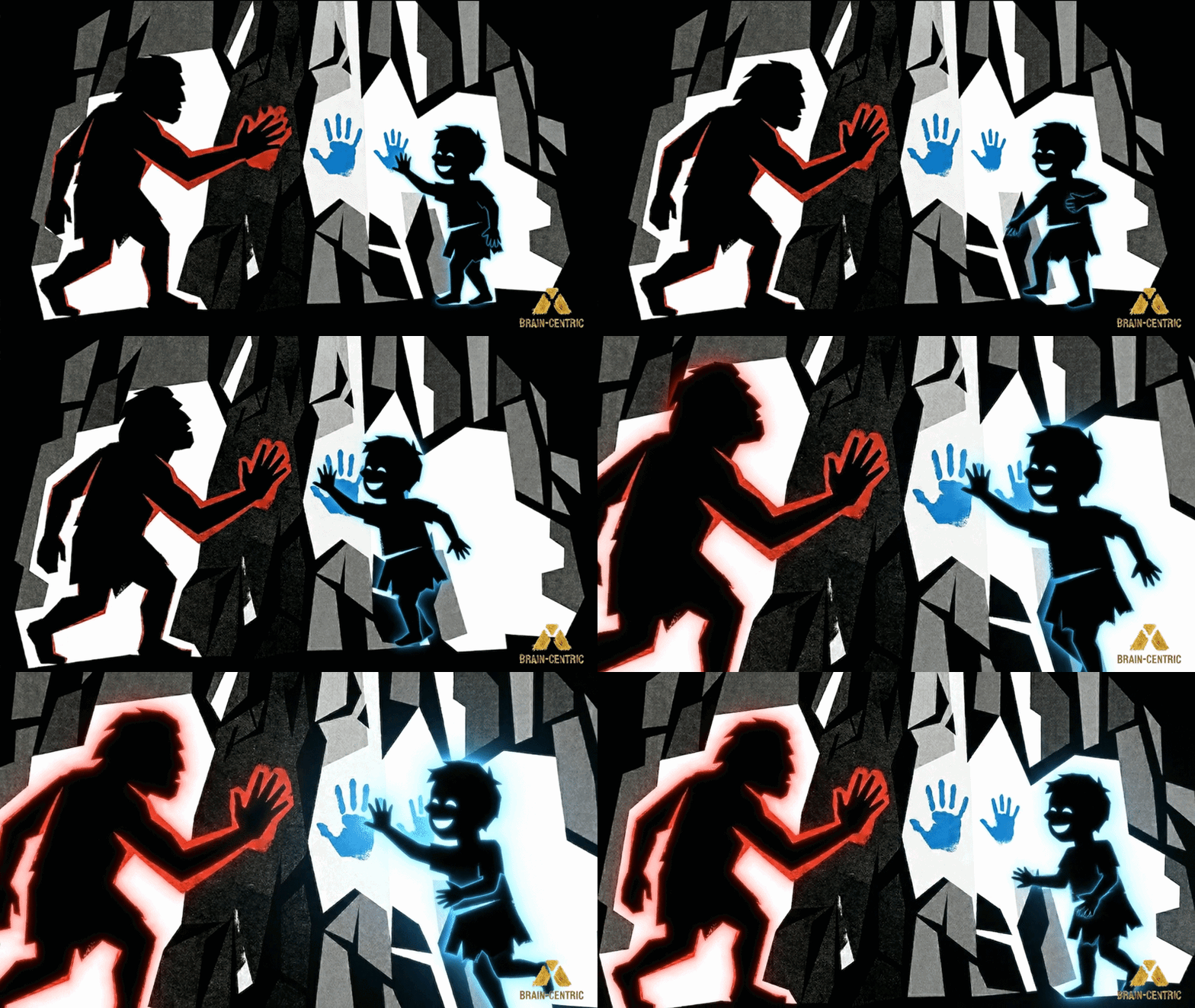
Thirty thousand years ago, in the Chauvet Cave in southern France, someone took a mouthful of red ochre, pressed their hand against the wall, and blew. What remained was the first abstraction in human history. A hand print. A declaration. I’m here and I want to create. I wrote about this in my first book, Brain-centric Design, because it represents the oldest known site of human artistic expression on Earth. The brain that produced that moment is the same brain sitting in your skull right now. Same architecture. Same forward-facing hunger. Same capacity to look at nothing and decide it needs to become something.
We have been doing this ever since. Every road cut through a mountain. Every song written about a feeling that had no name before the song named it. Every city that rose from a marsh or a desert because someone stood in the emptiness and saw what wasn’t there yet. The printing press. The telephone. The internet. The machine learning systems now generating more noise about human obsolescence than any technology in history. All of it came from the same place. A human mind that looked at nothing and thought: “…not for long.”
That’s the conversation the AI era keeps skipping. And it’s the one worth having now. Because the story of technology has never been about what the tool can do. It’s always been about what the human behind it was reaching for.
The AI era got it right, and wrong, simultaneously. It got right that something fundamental has changed. Decades of watching how brains process information tells me the Cognitive Divide is real. Benjamin Bloom mapped human thinking in 1956. Six levels, ascending from simple to complex. Remember. Understand. Apply. Analyze. Evaluate. Create. Educators built careers around it. Corporations structured training on it. Then, in roughly eighteen months between 2022 and 2024, artificial intelligence mastered the bottom three. Faster, cheaper, tireless, and without a bad day in sight.
What the era got wrong is the conclusion it drew from that fact. The conclusion that humans were on the losing side of something. The bottom three levels of Bloom’s taxonomy were never the point. They were the floor. The work humans were always meant to move through, not live in. What remains above that floor, the capacity to analyze, evaluate, and create, requires something no training set has ever produced and no compute budget will ever buy. It requires a self. A person with a history, a perspective built from decades of pattern recognition, a judgment forged in situations that didn’t come with instructions. The willingness to make a call when the data runs out and something is still required of you.
That six year old with the blue paint had it. School spent the next twelve years negotiating it away. The AI conversation spent the last two years suggesting it was already gone.
Every Substacker on Substack who woke up one day and decided that words in a newsletter could become a community, a business, a body of ideas worth building, did exactly what the person in the Chauvet Cave did. Looked at nothing. Decided not for long. The parent improvising love and judgment and wisdom for a child no manual was written for. The teacher who looked at a disengaged classroom and invented a new way in. The leader who held silence in a high-stakes room long enough to say something that actually mattered. These are people operating exactly where the machine cannot follow. Pay attention.
The machine is extraordinary, no doubt at all. Worth understanding, worth using, worth playing with, worth taking seriously as the most capable tool the species has ever made. And it is a tool. Made by humans. From nothing. The way everything worth having gets made. What it automates is the cognitive work that was never the destination. The retrieval. The summarizing. The application of existing frameworks to familiar problems. It clears the floor so the real work has room.
And the real work has always been the same. A mind reaching past what exists into what could. A human looking at the lines they were handed and choosing, deliberately and with full awareness, to take the blue paint somewhere else.
Three words in a live conversation landed because people already knew they were true. They have been true since a hand pressed against a cave wall in southern France and left something the world had never contained until that moment.
We made that. We make everything.
Humans are back.
We never left.