

Pause Is the New Speed
When compute owns fast, silence becomes the most powerful thing in the room.


There's a moment I keep watching happen in rooms I get invited into.
A senior leader - someone who built a real career, navigated actual complexity, earned their seat - gets asked to slow down and articulate why their instinct is right. Why this direction and not that one. What they're actually optimizing for.
The room gets uncomfortable. Fast people. Decisive people. For two decades, that was exactly what the job required. Fast meant sharp. Decisive meant confident. The room rewarded the instinct because there was no real-time way to audit it.
That audit mechanism now exists. It costs about twenty dollars a month.
When AI arrived, speed got automated. Retrieval got automated. The ability to surface information, draft a response, synthesize a report, generate options - automated, completely, bundled together and delivered faster than any human has ever worked. The tools feel powerful because they are powerful. The problem arrived the moment every person in every organization got access to the same tools, running at the same rate, producing work at the same volume.
Speed used to differentiate. When the differentiator disappears, what's underneath it becomes visible for the first time. What was underneath it, for a lot of people, was nothing. AI made the pool shallow enough to see the bottom.
This deserves careful framing, because what I'm describing is a cognitive pattern that got economically rewarded for a very long time.
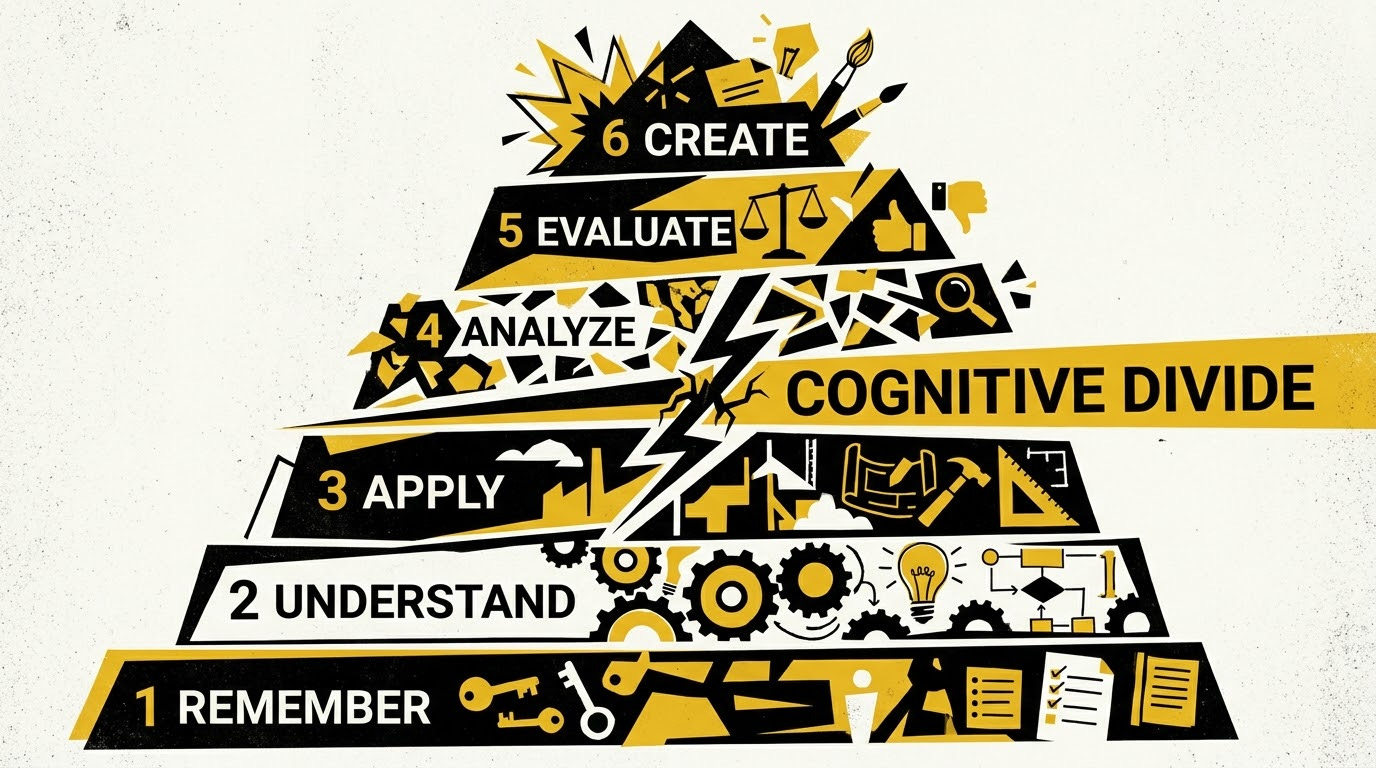
Benjamin Bloom's taxonomy - still the most peer-validated framework in cognitive science for how humans think - describes six levels of skill. The first three are Remember, Understand, and Apply. Genuinely useful skills. Also exactly what AI does, faster and at greater scale than any human on earth. I call these Commodity Thinking skills: abundant, reproducible, automatable. The top three levels are Analyze, Evaluate, and Create - where you break complex problems apart, make defensible judgments under genuine uncertainty, and generate ideas that did not previously exist. Premium Thinking. The Cognitive Divide is the categorical line between them. On one side, machines win and it isn't close. On the other, compute assists but cannot replace.
Nelson Cowan's landmark 2001 research established that the human brain holds approximately four chunks of information in working memory at any given moment. AI operates with no such constraint. The scarcity in the room has nothing to do with Cowan's constraint. The scarcity is the willingness to sit with genuine complexity long enough to form a judgment worth defending.
Compute resolves. Judgment commits. These are categorically different operations.
Here's a view from the body of a real person, in a real room, and it was epic.
I watched an executive field a high-stakes question recently at a Quarterly Business Review, the kind where the room of two hundred or so global folk lean in and the air pressure noticeably changes. He didn't answer immediately, instead, turned his head cockeyed and kind of giggled, and then paused. Ten to twelve seconds of full silence. A colleague moved to fill it and he held up a hand, quiet, without apology. The room held. When he spoke, the answer was so precisely reasoned, so clearly the product of someone who had actually thought rather than simply retrieved, the room deferred to it. Twelve seconds bought him the next several years of credibility in that organization.
Pause is the new speed.
In any high-stakes conversation, an orchestrated silence signals the one thing no AI can fake: a human mind doing the work in real time, on the actual problem, with full contextual weight. You can feel the difference. You always could. You just didn't have contrast before.
That contrast is everywhere now. In a period of economic pressure, when most discretionary spending in organizations is contracting, demand for this work has done the opposite. The organizations navigating genuine complexity are not cutting investment in judgment development. They are treating it as the one infrastructure spend that directly addresses the condition AI created. I have never been busier. That is not a boast. It is a data point worth understanding.
Speed created cover for a long time. When everyone operated at approximately human pace, the gap between someone who had genuinely analyzed a problem and someone who had a confident instinct about it was invisible. Both delivered a fast answer. The fast answer looked like competence. AI made the pool shallow enough to see the bottom. The confident instinct can now be tested immediately, checked, extended, challenged, and compared against seventeen alternatives in under a minute.
What remains - after the cover is gone - is the person's actual capacity to exercise judgment. It's a sexy word in the world because of its scarcity. Have you seen the price of a barrel of oil lately? Scarcity.
Judgment means you looked at the real options, understood the real tradeoffs, accounted for the actual context, and committed to a direction you can defend when the situation changes. You did the cognitive work rather than the cognitive performance of having done it.
The people who can do that work are becoming visible in ways they never were before. The contrast makes them legible. The people who built careers on speed alone are sitting with a discomfort that reads in the body before the mind catches up. The amygdala registers threat when the old proxy for competence stops carrying the old meaning.
Thinking is becoming attractive. Hard, economic, market-sorting attractive. The organizations navigating genuine complexity right now - making defensible decisions in unstable conditions, building things that hold together under pressure - are staffed by people who can analyze, evaluate, and create. Those people are becoming scarce in exactly the way manual labor became scarce when machines took over physical work. Their scarcity is visible. Their value is compounding.
The meek shall inherit the earth was always a patience argument.
The people who refused to perform certainty they hadn't earned, who did the cognitive work when the room was applauding the instinct, who sat with issue long enough to deeply understand it - those people built judgment that runs on something compute cannot reach. They have been in your organization the whole time. They were just harder to see when speed was the proxy for depth.
Use AI tools. Use them aggressively. AI is exceptionally capable at resolution. Give it a defined problem with retrievable information and it will outperform any human, every time. The problems worth solving right now are judgment problems. Problems that require someone to first decide what the actual question is, then determine which information matters, then evaluate the options against criteria that require human values and organizational context to establish. That sequence cannot be automated. The tools can assist at each step. The cognitive commitment that moves you from one step to the next lives somewhere else entirely.
The person who makes that commitment repeatedly, in high-stakes conditions, with reasoning they can defend, is the most valuable person in almost any room right now.
That person might be you. The question is whether you're developing that capacity deliberately or assuming it arrives with experience.
Deliberate is the word. Judgment is trained. And in a room that has gone quiet, twelve seconds can change everything.
Speed belongs to machines now. Judgment never did. The gap between those two things is where your career lives.
Rich Carr is the founder of Brain-centric Design, the only methodology built to develop the thinking that sits above the Cognitive Divide. Validated across Fortune 100 organizations including Nike, CVS, Microsoft, and the Department of Defense, in 20+ countries. If this framework landed, your next step is at brain-centric.com.