

Premium Thinking
The cognitive skills that command market value

"So what do you actually do?"
I've heard that question a thousand times. And for twenty years, my answers made people scrunch their forehead, nod in a somewhat knowing kind of way and from there, it was hit or miss.
Late last quarter, a Fortune 500 CLO asked me the same question on a discovery call over Zoom. I refined the answer into something simpler but profound.
"I develop Premium Thinking…the cognitive skills AI can't replicate."
She didn't nod. She pulled up her calendar.
The World Economic Forum just published its Future of Jobs Report 2025. Over 1,000 global employers. Fourteen million workers surveyed. One skill at the top of the list for the third consecutive year: Analytical thinking. Seven out of ten companies consider it essential. Not “nice to have.” Essential.
I didn’t design my career around this moment. But as the data continued to mount, I realized I’d been training the exact capabilities that now command premium wages -while most of the world was busy learning skills that AI would automate.
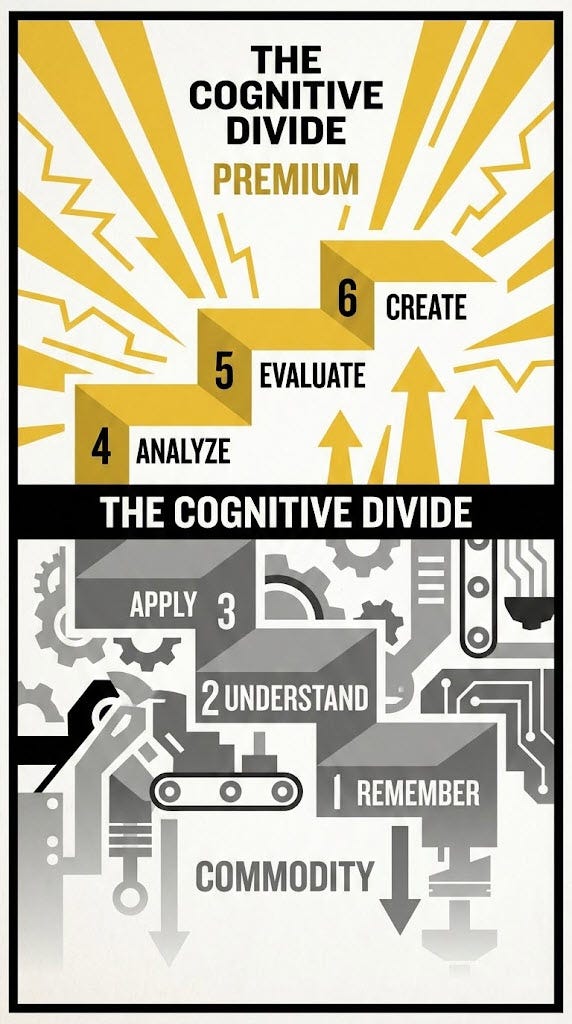
The numbers tell a clear story, so let me show you something that changed how I think and position what I do…
☑ 70% of employers consider analytical thinking essential (WEF 2025)
☑ 63% cite skills gaps as their primary barrier to transformation
☑ 39% of current skills will be obsolete by 2030
☑ 59% of workers will need reskilling—and 11% won’t receive it
☑ 66% of tasks will still require human skills or human-AI collaboration by 2030
☑ 83% of employees believe AI will make human skills more critical, not less
I spent years referring to this as “brain-centric methodology.” I talked about neural pathways, prediction error, and cognitive load.
Many cared, and we’re now the recognized authority in applying premium thinking to businesses ’ most significant problems: onboarding, conversations, sales, learning & development, and personal elevation. But it was too ‘sciency,’ and after a while everyone was ‘speaking brain,’ and even though that was gratifying, what was missing was literal, intrinsic meaning: that we all have the same brain that operates in much the same manner, mechanically.
“But what does this mean for me?” It was that question that led me to call it what it actually is: the thinking that commands higher pay because machines can’t replicate it and employers can’t find enough people who can do it.
Voila, Premium Thinking.
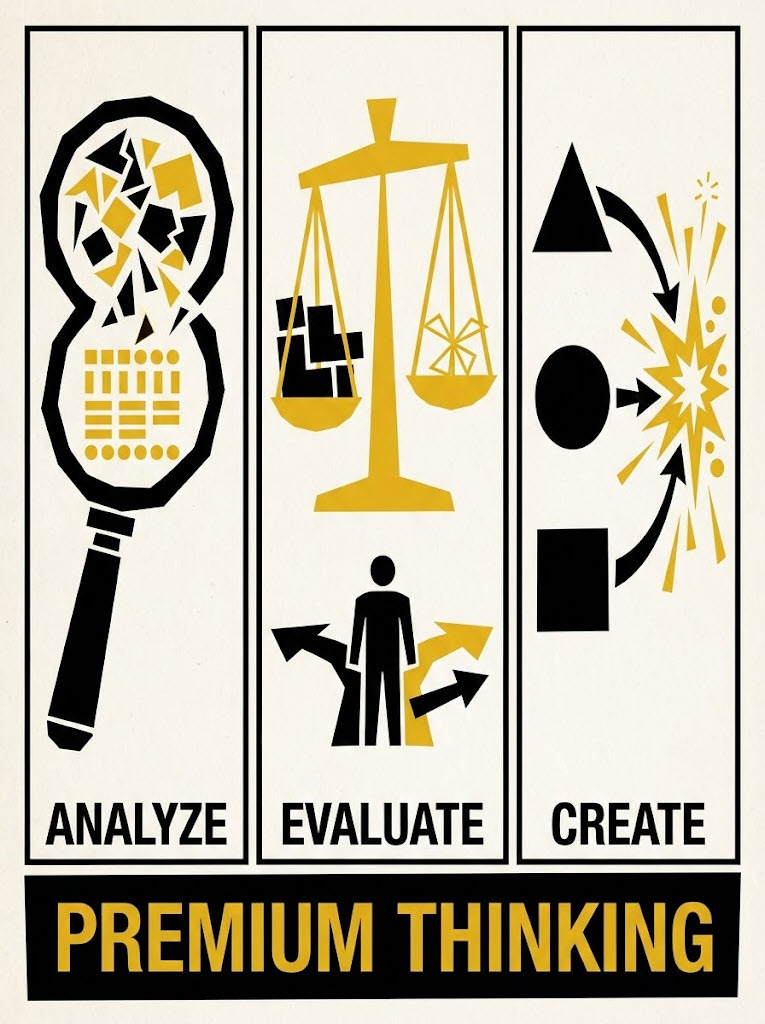
The term isn’t borrowed. It isn’t diluted. It describes specific cognitive operations -analyze, evaluate, create - that sit at the top of Bloom’s Taxonomy and at the top of employer demand.
Now here’s where it gets interesting...
A pharmaceutical executive once recounted to me over the holiday a presentation that nearly ended her career this last quarter. She was three slides into defending a controversial call center presentation when she sensed the room turning against her. Instead of continuing, she closed her laptop.
“You know what?” she said. “Everything I’m about to show you is going to feel like justification for a decision you think I’ve already made. That’s not what’s happening here. Let me start over.”
She spent the next twenty minutes asking questions instead of providing answers. The presentation was approved unanimously.
What happened? She crossed the Cognitive Divide.
Below that line, you compete with AI on information assembly -and you lose. Above that line, you read the room, synthesize conflicting perspectives, and make judgment calls under ambiguity.
That’s Premium Thinking in action. And it’s why her career endures to this day. You’re experiencing AI’s Commodity Thinking more and more daily. Learn to use AI to elevate your Premium Thinking.
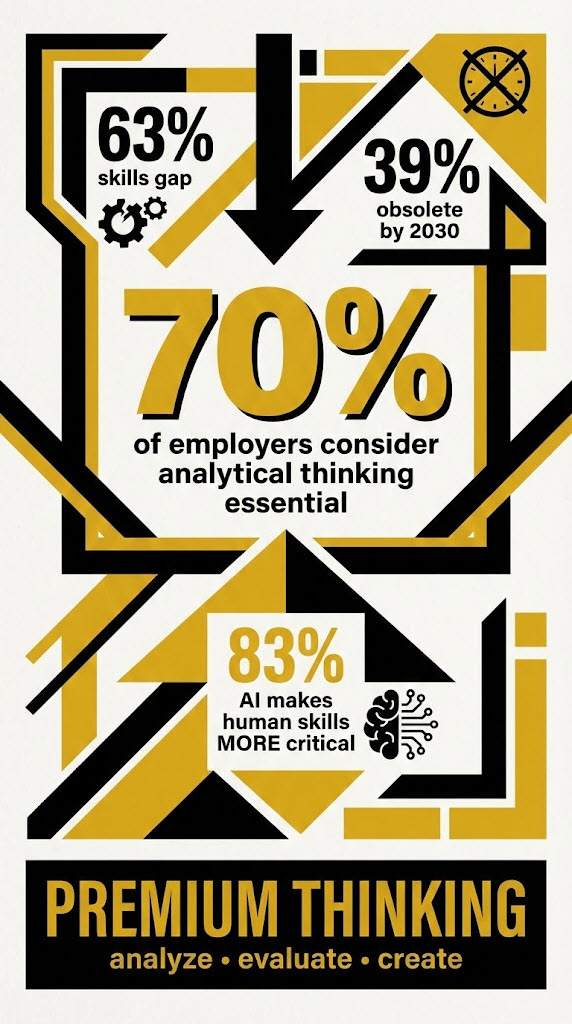
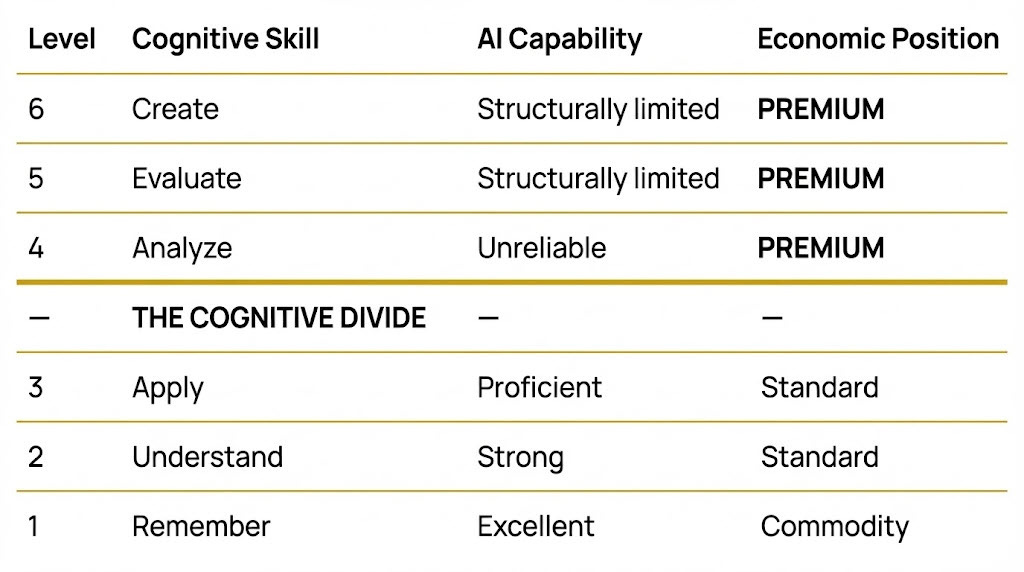
The dividing line above isn’t arbitrary. It marks where AI capabilities structurally degrade and where human cognitive value structurally increases. Spend a moment with it. Understand the table’s position in your life right now. Opportunity is obvious when you give it a little reflection. Ask yourself after reviewing it, “What was surprising?”
MIT Sloan’s 2025 EPOCH research provides the definitive framework. The acronym captures what AI structurally struggles with:
☑ Empathy
contextual emotional intelligence
☑ Opinion
ethical judgment under ambiguity
☑ Perception
creativity and imagination
☑ Openness
adaptability to novel situations
☑ Courage
hope, vision, leadership
Here’s the part that matters: MIT researchers deliberately refused to call these “soft skills.”
As Roberto Rigobon states: “A ‘hard’ skill, like solving a math problem, is comparatively easy to teach. It is much harder to teach a person these critical human skills and capabilities.”
Premium Thinking isn’t a category. It’s three specific cognitive operations…three particular & focused ways to think.
1. Analytical Thinking
Breaking complex problems into components. Identifying patterns across noise. Distinguishing signal from distraction.
I watched this play out recently with a software company pitching a Fortune 500 client. The vendor had prepared forty-three slides of comprehensive analysis: competitive positioning, implementation timelines, risk mitigation strategies. Pure logic.
The client sat through the entire presentation, asked thoughtful questions, and complimented their thoroughness, and contacted me in hopes I had something ‘different’ then “What’s available…” Then, they chose my simpler, less comprehensive solution.
Why? Because I had done something different without (until after the fact) knowing why my predecessor failed. I didn’t just analyze the problem - I analyzed which analysis the client actually needed. I distinguished the signal (what decision would make this executive look good) from the noise (comprehensive data that created cognitive burden).
That’s analytical thinking. Not more data. Better pattern recognition of what data matters.
2. Evaluative Judgment
Assessing quality. Making decisions under uncertainty. Choosing between imperfect options when values conflict.
Complete this sentence: “She poured herself a large cup of ___.”
Tea? Coffee? Those are the usual suspects.
Now imagine I told you: gravy.
Your brain just did something interesting. It paused, recalibrated, and assessed whether “gravy” could possibly be correct. You might have tilted your head one way or another. You didn’t just retrieve information - you evaluated unexpected input against your existing framework.
This is what AI struggles with: not retrieval, but judgment. When the input doesn’t match the training distribution, when the problem itself requires interpretation, when values conflict, and someone has to decide.
Evaluative judgment is the ability to stand in ambiguity and still move forward. AI can generate options. It cannot tell you which option to choose when the criteria themselves are contested.
3. Creative Synthesis
Generating novel solutions. Combining disparate elements. Producing original work that didn’t exist before.
The pharmaceutical executive who closed her laptop didn’t just interrupt a pattern. She synthesized a new approach from the fragments of what wasn’t working. A bold move, but needed in her eyes. The ‘surprise’ helped make it successful. They were paying attention when she closed that laptop….
She read defensive body language (observation). She understood that more data would make resistance worse (analysis). She judged that collaboration was more valuable than persuasion (evaluation). Then she created something that didn’t exist a moment before…a new frame for the entire conversation. That’s synthesis. Not generating more content. Generating the right container for content to land…you’ve got to clear the runway before you land the plane.
The market is cluttered with competing terminology for these thinking skills, each carrying problematic baggage, which led to this post.
“Soft Skills”
Implies secondary importance. Has been diluted to include empathy, vulnerability, and emotional wellness.
“Durable Skills”
Better branding, but the category has expanded to include everything from collaboration to resilience.
“Human Skills”
Too broad. Every skill humans have is a “human skill.” Lacks economic specificity.
“Higher-Order Thinking”
Academic jargon. Sounds theoretical. Doesn’t communicate market value.
“Power Skills”
LinkedIn’s attempt. Yawn…lost momentum. Cliche. Now synonymous with professional development generics.
Premium Thinking solves the positioning problem.
“Premium” signals economic value - not aspiration. “Thinking” signals cognitive operations - not personality traits. Together, the term claims specific territory: the analytical, evaluative, and creative work that commands higher compensation because the market cannot find enough of it and machines cannot replicate it.
Economic research has documented the cognitive wage premium for decades, but AI has exposed it in less than a year and a half.
The landmark NBER study “The Growing Importance of Cognitive Skills in Wage Determination” demonstrated that basic cognitive skills had a larger impact on wages in the 1980s than technical credentials - and this premium has persisted.
A 2024 Review of Economics and Statistics study found that occupations requiring “intellectual tenacity” - the persistence to solve novel problems—pay significantly higher wages even after controlling for education, demographics, and cognitive ability requirements.
Hamilton Project research shows the earnings trajectory rises sharply with both cognitive and higher-order thinking skills.
This isn’t opinion. This is measurable market value.
The demand exists. The supply is scarce. The price increases.
That is what “premium” means.
The Definition
I want to be precise about this.
PREMIUM THINKING
The cognitive skills - analyze, evaluate, create - that command economic premium because AI cannot perform them reliably and employers cannot find enough workers who possess them.
Premium Thinking includes…
☑ Analytical Thinking — Breaking complex problems into components, identifying patterns across noise, distinguishing signal from distraction
☑ Evaluative Judgment — Assessing quality, making decisions under uncertainty, choosing between imperfect options when values conflict
☑ Creative Synthesis — Generating novel solutions, combining disparate elements, producing original work that didn’t exist before
Premium Thinking excludes:
Emotional intelligence (important but distinct)
Resilience and adaptability (valuable but categorical)
Communication skills (necessary but separate)
Technical literacy (complementary, not core)
This precision is the point. Premium Thinking is trainable, measurable, and economically valuable. It is not a personality type, a disposition, or a workplace culture aspiration.
Three Premium Thinking Rules for 2026
1. Stop competing with AI on information. Start competing on judgment.
The most comprehensive presentation often loses. The clearest evaluation of what actually matters wins.
If your professional value rests on assembling better facts, you’re about to be automated. If your professional value rests on helping others decide what facts mean, you’ve just entered premium territory.
2. Use AI to elevate, not replace.
This is what I call the Elevation Effect.
AI should handle the cognitive tasks that consume bandwidth - research, drafting, organization - so your mental resources become available for the work AI cannot do: reading the room, making judgment calls, creating novel solutions.
The pharmaceutical executive could have spent days building her case manually. Instead, she could have spent five minutes with AI generating a psychological profile of board concerns, then walked in with full cognitive capacity for real-time evaluation and creative pivot.
It’s the same outcome using an entirely different cognitive operating model.
3. Train the capability, not the content.
Content expires. Premium Thinking compounds.
The specific skills that will matter in five years? Unknown. The cognitive operations that make learning those skills possible? Those are the same operations that have mattered for decades - and they’re now worth more than ever.
I’m not rebranding soft skills; I’m recognizing an economic reality that the research makes undeniable. Specific cognitive operations - analyze, evaluate, create - command market premium because:
☑ They sit at the top of cognitive taxonomy (Bloom’s 4-6)
☑ They occupy the space where AI structurally fails (MIT EPOCH research)
☑ They command documented wage premiums (NBER, Hamilton Project)
☑ They rank #1 in employer demand (WEF 2023, 2024, 2025)
☑ They represent the scarcest capability in the market (63% skills gap)
The term isn’t borrowed. It isn’t diluted. It isn’t available for category creep.
Premium Thinking is the work I’ve been doing for more than 20 years - now with the economic proof that makes the value undeniable.
If you found this useful, share it with a friend. I’d appreciate it. I also wrote three books on how people think: Brain-centric Design (how the brain processes new information), SURPRISED (how to engage), and Invisible Influence (how to get people to adopt your ideas). All three are really about the same thing: the Premium Thinking that separates humans from machines.
Sources
World Economic Forum — Future of Jobs Report 2025
MIT Sloan — “The EPOCH of AI: Human-Machine Complementarities at Work” (Loaiza & Rigobon, 2025)
NBER — “The Growing Importance of Cognitive Skills in Wage Determination” (Murnane, Willett, Levy)
Hamilton Project — “Seven Economic Facts on Noncognitive Skills” (2024)
Journal of Economic Literature — “The Role of Cognitive Skills in Economic Development” (Hanushek & Woessmann)
Love the term "premium thinking", Rich! I learn so much each time you post.
I wrote this piece for me to make my thinking visible as the tides of L&D and people management are changing rapidly with more businesses are asking, "Alright, we have AI. Now what?" This post is me rewriting what we've been engaged to do with a Fortune 500 beginning soon, and I'm replicating globally with others.