

Self-Identity On Demand
The Premium Thinking Skill of Becoming Who You Need

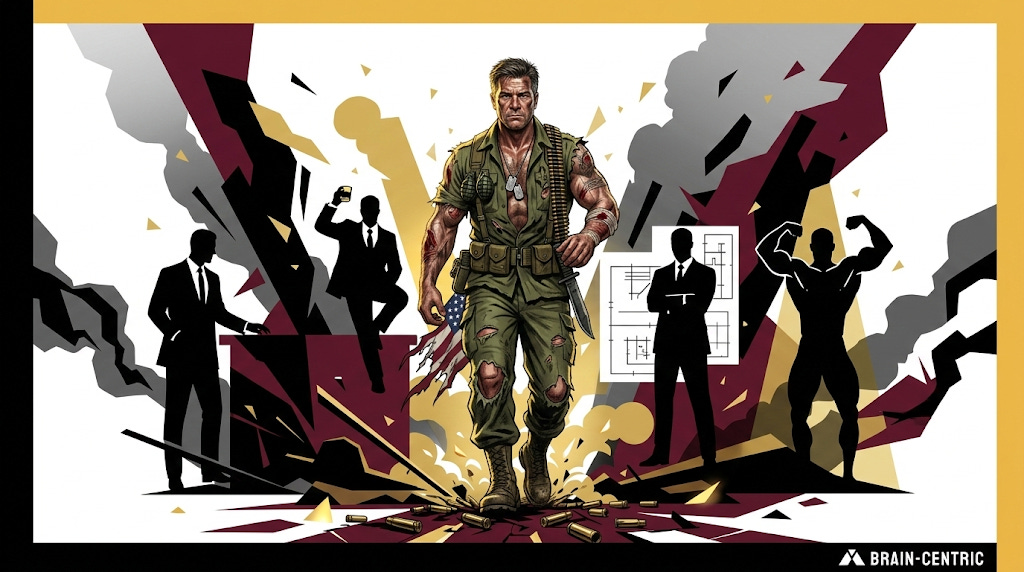
When I was 19, I joined the Army to pay for college. I had already completed two years but couldn’t continue the cost, so I signed up for an 8-year hitch in the early ‘80s to pay for it all. In late June of that year, I flew across the country in the middle of the night, Jim Morrison hair & beard, drinking Manhattans, landed in Philadelphia, and got bused to the Fort Dix Army in-processing center. Home of ‘The Ultimate Weapon.’
I regretted the decision immediately.
The fluorescent lights. The multilingual multi-dialect yelling, barking, crying. The shaved heads moving through hallways like foreign cattle breeds. The smell of industrial cleaning solution and someone else’s fear hung like an omnipresent slurry of dank on the senses. My brain was screaming one thing on repeat: You made a terrible mistake.
And then something happened that I wouldn’t understand for another forty years.
I became Sgt Rock.
Not metaphorically or as some fleeting motivational thought. I became him. The DC Comics war hero who never breaks, never flinches, who treats impossible situations like Tuesday. In my head, the entire architecture of who I was shifted. And basic training - that place I was trapped at and signed up for - breezed by in a comic book world where no exercise, no low crawl, no discipline, no screaming drill sergeant could touch me. When fearlessness was needed, Sgt Rock showed up. When physical stamina hit the wall, Sgt Rock pushed through. When doubt crept in at 3 AM while tracer rounds squealed and whistled as they zipped above my head, hitting the berm an arms length behind me with sharp thuds, Sgt Rock found it amusing.
At the time, I thought I was just playing pretend to survive. What I’ve since researched is that I was accessing something far more sophisticated - something now known as Self-Identity On Demand. The brain’s built-in ability to select and load a different identity model for a specific environment. I just didn’t have the language for it yet. I didn’t have the neuroscience for it either. But the neuroscience was there, running underneath everything, whether I understood it or not.
Your brain doesn’t experience reality. It predicts reality. Neuroscientist Karl Friston’s research on the free energy principle shows that your brain is constantly running models…forecasting what will happen next based on everything it already believes about who you are, where you are, and what’s about to go wrong.
That ‘wrong’ part matters. The brain is biased toward threat detection. In other words, it’s trying to keep you alive rather than trying to keep you happy. And the predictions it generates are filtered through something most people never examine: your identity model.
Your identity model is the brain’s answer to a deceptively simple question: Who am I in this situation?
When 19-year-old Rich landed at Fort Dix, his identity model answered: I’m a college kid who can’t afford tuition. I’m in over my head. This was a mistake. Every prediction the brain generated flowed through that model. Drill sergeant yelling? Threat - I don’t belong here. Five-mile run at dawn? Threat - I’m not built for this. Communal everything with strangers exhibiting questionable personal quirks? Threat - THIS is not my world.
The amygdala was running a bonfire. Cortisol was on tap. Every experience confirmed the prediction: You have errored.
The moment I became Sgt Rock, I didn’t change my attitude. I didn’t give myself a pep talk. I sure the hell wasn’t “thinking positive” or looked at that as an option.
I swapped the predictive model.
Sgt Rock’s identity model answered the brain’s question completely differently: I’m a soldier who thrives under pressure. Nothing breaks me. This is exactly where I belong.
Everything else was the same…same barracks, same PT, same screaming sergeants. But the brain’s prediction engine was now running every calculation against a different identity. And those predictions came back manageable. Survivable. Even fun.
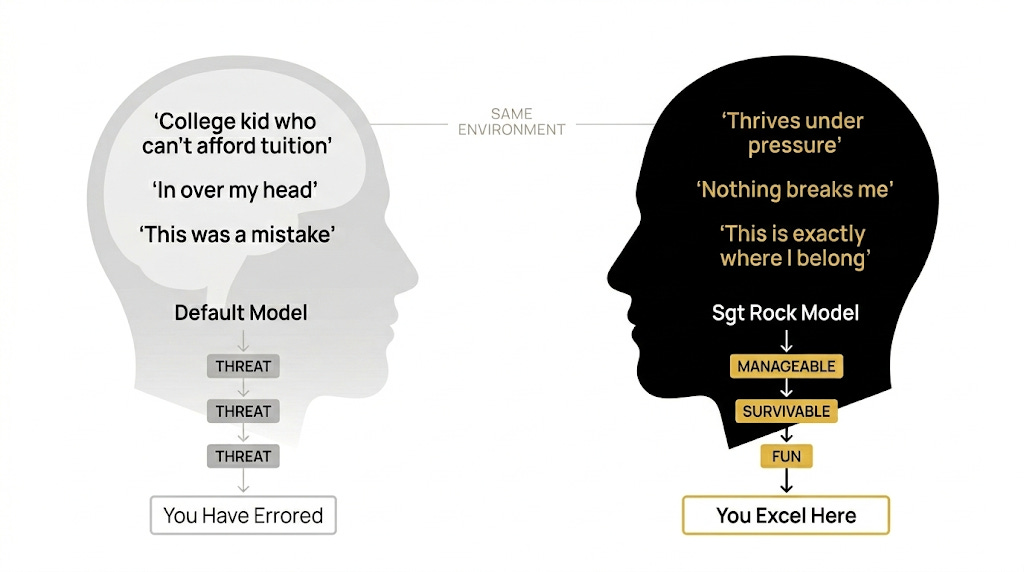
The brain didn’t care that Sgt Rock was fictional. It cared that the model worked. Predictions matched experience. Threat level dropped. Cognitive load plummeted. And suddenly I had bandwidth - actual mental resources - available for performance instead of panic.
I can think this way or I can think that way.
That’s the part nobody tells you about Self-Identity On Demand. It’s not pretend and it’s not acting…it’s architecture. And your brain is already wired for it.
Forty-plus years later, the wiring hasn’t changed. I’ve just learned to use more of it. I’m 62 now, and I still do this. I just have a bigger roster.
Walking into a tough negotiation? Super Sales Guy shows up. He’s calm under pressure, reads the room like sonar, treats objections like invitations, dresses nice, but not too nice, comfortable/professional nice. The boardroom doesn’t make him nervous because nervousness isn’t in his model.
Social event where I, an INFJ, need to work the room? Joe Charm takes the wheel. He genuinely likes people, finds everyone interesting, engages with a minimum of five people in actual conversations, remembers names like they matter…because in his model, they do.
Solving a complex problem that needs unconventional thinking? Elon Rich loads up. He doesn’t respect “how it’s always been done” because that phrase doesn’t exist in his operating system. He finds the source and questions it. He makes things simple and not simpler. He’s not really concerned with what you think of that, or the temperature of his tea, either.
In the gym? Frank Zane. The legendary bodybuilder whose physique was about precision, not just power. When Frank Zane is running the model, I don’t skip sets. I don’t cut corners. I focus on form. I eat right, I sleep right. Mediocre effort isn’t a prediction his identity generates.
Each persona is a complete cognitive architecture optimized for a specific environment. Different identity model. Different predictions. Different performance. I have others. Self-Identity On Demand isn’t one alter ego. It’s a roster - selected deliberately, loaded strategically, deployed for the environment you’re actually in rather than the one your default model prepared for.
And before you decide this sounds unhinged, let me ask you something…
When’s the last time you walked into a job interview and weren’t performing a version of yourself? When’s the last time you spoke to your boss the same way you speak to your best friend after two beers? When’s the last time you parented exactly the way you negotiate?
You already have personas. Everyone does. You just never named them. And because you never named them, you never chose them. They chose you, based on whatever emotional weather your brain was running that morning.
That’s the difference. I’m not doing something abnormal. I’m doing something most people do accidentally - on purpose.
Which is probably where your brain starts pushing back. I can feel the objections forming as I type this.
Isn’t this just… becoming somebody else? And isn’t that a problem?
Fair question. Wrong frame.
When you speak Italian in Rome and English in Seattle, you aren’t becoming somebody else. You’re selecting the communication architecture that fits the environment. Your identity doesn’t fracture when you switch languages. Your identity adapts.
Self-Identity On Demand works at the same level, just one layer deeper.
Your identity isn’t a single fixed point. It never was. The neuroscience is clear on this. Lisa Feldman Barrett’s research shows the brain constructs your sense of self in real time, moment to moment, assembling it from context, memory, body state, and prediction. There is no little “you” sitting in a control room being authentic. There’s a dynamic system constantly asking who do I need to be right now to navigate this effectively?
You already answer that question dozens of times a day. You just don’t notice.
The voice you use with your kids at bedtime is not the voice you use in a budget meeting. The patience you access while teaching someone a new skill is not the patience you access in traffic. The courage you summon for a difficult conversation with your boss is not the same courage you summon to check your bank account in January.
Same you. Different operating mode.
What I’m describing isn’t identity replacement. It’s identity selection. You’re not becoming somebody else. You’re choosing which version of yourself to bring forward and giving that version a name so your brain can access it faster.
An important distinction here is that you’re selecting from capabilities that already live inside you. Sgt Rock didn’t give me skills I didn’t have…I was physically fit, I was mentally tough, I just couldn’t access those things through the identity model that was running when I stepped off that bus. The persona removed what was blocking what was already there. It didn’t install something new. Self-Identity On Demand doesn’t make you someone you’re not. It clears the path to someone you already are but can’t reach when your default model is running interference.
One of my students once told me: “The way I see it, I’m me, just not me.”
That’s exactly right. And that’s exactly the point.
The “not me” part is what makes it work. That slight distance - psychologists call it self-distancing - is what lowers the amygdala’s threat response and frees up cognitive bandwidth. You’re not pretending to be someone you’re not. You’re giving your brain permission to operate without the baggage your default identity drags into every room.
Sgt Rock wasn’t someone else. He was me without doubt.
Super Sales Guy isn’t someone else. He’s me without the overthinking.
Joe Charm isn’t someone else. He’s me without the social calculation.
You don’t choose a persona for what it removes. You choose it for what it carries, the qualities you admire, the capabilities you want access to. Sgt Rock brought loyalty, leadership, an unbreakable calm. Super Sales Guy brought focus, charisma, the ability to read a room like weather. Joe Charm elevated charisma, active listening and connection vibes. The subtraction is real - doubt disappears, overthinking quiets down, groups of people are more inviting - but it’s a side effect, not the point. You reach for the model because of what it brings. What falls away is just what couldn’t survive in its presence.
The persona doesn’t add something foreign. It subtracts something expensive. That’s what makes Self-Identity On Demand so powerful…it doesn’t ask you to become more. It asks you to carry less. And I’d rather you feel that than just read about it.
FEEL IT…
I want you to test this right now. It’s simple and requires a tiny bit of thought. Right now, while you’re sitting wherever you’re sitting, reading this on whatever screen you’re reading it on try this…
Think of someone you admire - real or fictional - who handles a specific situation better than you do. Not better in general. Better at one thing. Maybe they’re unshakeable in conflict. Maybe they’re effortlessly warm with strangers. Maybe they stay disciplined when motivation disappears. Maybe they say the hard thing without flinching.
Got them? Good. Now give them a name if they don’t already have one. If it’s a real person, use their name. If it’s a quality you’re reaching for, name it something that feels right. The Professor. Iron Jane. Cool Hand You.
Now here’s the shift.
For the rest of this article - just the next few minutes of reading - I want you to read as that person.
When you hit the next paragraph, don’t process it as you-with-your-usual-doubts. Process it as the person who handles things the way you wish you did. Let their model run. Let their predictions operate. Get into it, be deliberate. If your chosen persona is someone who takes bold ideas seriously instead of deflecting with skepticism, let that happen. If they’re someone who immediately looks for application instead of reasons it won’t work, let that happen.
You’ll feel a small shift. It might feel like straightening your posture. It might feel like your inner voice changing tone. It might feel like nothing…until you notice you’re reading differently. More openly. With less resistance. With a quiet confidence that isn’t yours, except it is.
That’s the model swap. It took you about fifteen seconds.
And if you’re being honest, something just changed in how you’re sitting with this article all of the sudden. That’s not a trick either. That’s your cognitive architecture doing exactly what it was built to do…running the identity model you selected instead of the one that showed up by default when you started this missive. You just experienced Self-Identity On Demand. For the first time deliberately. In a chair. Now imagine doing that before every meeting, every negotiation, every difficult conversation, every workout, every time you want to for effect.
Welcome to the roster.
Now, here's the rub you weren't expecting…you’ve been on someone else’s roster longer than you realize.
Every nickname is a lightweight identity load. When someone calls you “Chief” at work, your brain doesn’t just hear a word. It runs a quick prediction update: I’m the person in charge here. When your grandmother called you her “little genius,” she wasn’t complimenting you. She was building architecture. Your brain filed that model and reached for it every time a math test landed on your desk.
The pet names in your closest relationships are the most revealing. They are substantially more than decoration, ‘Boo,’ they’re invitations to run a specific model. “Babe” loads something different than your legal name. “Stud Muffin” loads something different than “hon.” “Cuddle Bumpkins” loads softness, safety, tenderness, an entirely different prediction set than the one you were running five minutes ago in a work email. Each name tells your brain which version of you this person wants to interact with right now. And your brain obliges, because the model feels safe and the relationship confirms it.
This works in the other direction too. The kid who gets called “the quiet one” by a teacher isn’t being described. They’re being assigned an identity model. And their brain will run predictions through it: I’m the quiet one, so speaking up would violate my model, so I stay silent. The prediction confirms itself. The nickname becomes architecture. The label becomes the cage. To label is to limit.
This is why the wrong nickname feels so viscerally wrong…not annoying, but almost threatening. When someone assigns you an identity model that conflicts with the one you’re running, your brain registers it the way it registers any prediction error. It’s not that you dislike the name. It’s that the model doesn’t fit, and your brain has to either adopt it or defend against it.
Self-Identity On Demand isn’t something unusual that elite performers figured out. It’s something humans do to each other constantly. Your parents did it when they called you their little artist, their tough kid, their old soul. Your coaches did it when they called you Captain, or Jack-wagon. Your partners do it tonight when they call you something that makes you stand taller or soften completely.
The only difference between a nickname and an alter ego is authorship. One is assigned. The other is chosen. Self-Identity On Demand is the decision to stop outsourcing that authorship and start writing your own.
Which brings you back to that exercise you did a few minutes ago. You picked someone. You named them. You read through the nickname section as that person instead of as yourself.
Something shifted. Maybe it was subtle. Maybe it surprised you.
DO IT…
Now I want you to think about three situations in your life where your default identity model consistently underperforms. The meeting where you shrink. The conversation you avoid. The challenge you keep almost starting. The room you walk into already defeated.
For each one, answer one question: Who would I need to become - not someone else, but which version of me would I need to load - to change the predictions my brain is running?
Name them. Seriously. Right now. Have fun with it. The name is what makes it accessible. The name is what turns a vague intention into a cognitive shortcut your brain can grab in the moment it matters.
Because that moment is coming. It always is. And when it arrives, your brain is going to ask the question it always asks: Who am I in this situation?
Right now, your default answers for you.
After today, you answer for yourself.
That’s Self-Identity On Demand. A Premium Thinking skill. One that a 19-year-old kid with Jim Morrison hair and Manhattan courage tapped into after a bus ride to Fort Dix before he had a single word for what was happening.
He called it Sgt Rock.
What will you call yours?
Rich Carr is the author of Brain-centric Design, SURPRISED, and Invisible Influence. He teaches thinking skills that AI cannot replicate - including Self-Identity On Demand - to Fortune 100 companies and writes about the Cognitive Divide at braincentric.substack.com.
---
Rich, this is brilliant — and I want to add a layer from 40+ years of clinical neuropsychology that I think deepens your point in a direction your readers need to hear.
What you're describing as Self-Identity On Demand — this deliberate swapping of the predictive model — is the *conscious, adult* version of something the brain already does involuntarily to keep children alive. You did it intentionally at 19 with Sgt Rock. But children in single digits who are subjected to extreme abuse, torture, or who witness violent crime do this without choosing to and without knowing they're doing it. Their brain doesn't ask permission. It just builds another place to go.
I watched this happen in real time early in my career. A seven-year-old girl I was holding in a physical restraint during a four-hour tantrum shifted right in front of me — not calming down, not giving up, but *leaving*. Going somewhere else in her mind where what was happening to her wasn't happening to her. That moment sparked my entire trajectory into neuropsychology.
Your brain's first job is to make sure you survive. If that means constructing a separate identity — whether it's Sgt Rock on a bus to Fort Dix or a dissociative state in a child who has no other escape — so be it. This isn't a premium thinking skill you have to teach people to access. It's one of our most primal survival mechanisms. We are *born* with this wiring.
The difference — and this is where your work gets important — is authorship. The abused child doesn't choose the identity that forms. It gets built in the dark by a desperate brain. What you're teaching people is how to take that same architecture and use it with intention, with awareness, with a roster instead of a trauma response. That's the leap. That's what makes your framework powerful — not that it creates something new, but that it puts conscious hands on something the brain has been doing since before we had language for it.
Beautifully done. This deserves a much wider audience.
Wow, Rich, what a fascinating read, and what a fascinating exercise for the mind.