

Sharper Thinking Isn't An Advantage
It's the only one left.


The room had seventeen people. All of them had read the same brief, run the same queries, seen the same dashboards. Within a few minutes of the meeting starting, it was clear: fourteen of them had nothing to add. nadda…zilch….
The fourteen weren’t stupid; they were merely informed. This is the new normal.
Information used to be the bottleneck. Now it’s the baseline. Every competitor, every colleague, every Substacker, every candidate has access to the same models as you or I do, their tech stack, the same summaries, the same “insights.” The playing field didn’t level…it flattened with AI. poof…gone….
Which leaves one differentiator: what you do with the information once you have it.
History swings in cycles. In Pendulum: How Past Generations Shape Our Present and Predict Our Future, Roy Williams and Michael Drew documented an 80-year rhythm between “Me” eras and “We” eras… individualism versus collectivism, each lasting roughly 40 years before the culture swings back. They traced the pattern across 3,000 years.
Go back exactly 80 years to 1945. America had just won a war through collective sacrifice; rationing, war bonds, shared purpose. The GI Bill passed, described by historians as “the last great collective social experience” in American history. By 1947, 49 percent of college students were veterans….an entire generation lifted together. Individualism took a backseat. The “We” era was at full height.
Go back 40 years to 1985. Midpoint of a “Me” cycle. Reagan, Gordon Gecko, Yuppies, individual achievement celebrated. Yet even then, the pendulum hinted at its return: 45 of the biggest names in music gathered to record “We Are the World.” The press noted that musicians from rival factions of the business were putting aside differences of style and temperament and coming together. Collective action breaking through an individualist era. A preview.
Now look at 2025. We crossed the fulcrum in 2003. We’re climbing toward the “We” zenith. The most powerful thinking tools in human history are free and available to everyone with an internet connection. Shared. And they’re being built through collective contribution…millions of conversations, feedback loops, and human corrections shaping systems that belong to no one and serve everyone.
The pendulum swings. And as you read this it’s swinging toward “We.”
Here’s the tension: collaboration requires contribution. In a “We” era, the question isn’t what do you have? It’s what do you bring?
When everyone has access to the same information, bringing more information isn’t a contribution. Bringing sharper thinking is.
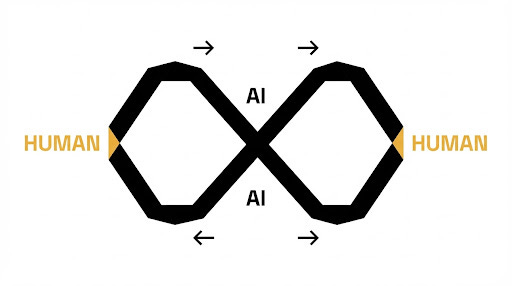
There’s a cognitive rhythm to working with AI that separates those who use it from those who are used by it. At Brain-centric, we call it the Thinking Loop: Human → AI → Human → AI. The pattern matters. You start with a question only a human would ask…one shaped by context, stakes, relationships, or constraints that no model can see. AI returns information. You interpret that information through judgment, experience, and consequence-awareness. Then you go back to AI with a sharper question. And so on.
Each pass through the Thinking Loop compounds. The human phases do the heavy lifting: framing, filtering, synthesizing, deciding. AI handles retrieval and computation.
Collapse the human phases - let AI do your thinking - and the loop flatlines. You become a conduit, not a contributor.
Those fourteen people in the meeting room? They’d stopped at the first AI output.
They had information. They hadn’t thought.
Sharp thinking isn’t complexity, but it is learned. It’s clarity under pressure. It’s the ability to ask the question no one else thought to ask.
See the pattern in the data that tools missed.
Hold contradictions long enough to find synthesis.
Know when the “right” answer is wrong for the situation.
Know when to look past the first right answer.
None of these are tasks AI can perform. They’re all tasks AI makes more valuable because AI handles everything except them.
Check out the irony that surfaces: the more powerful AI becomes at information retrieval, the more valuable human cognition becomes. Not less. You are the very thing the technology is trying to replicate. The more it advances, the more it reveals what it can’t do.
This isn’t a productivity hack either. It’s a frame for seeing your role in any room, any project, any organization.
Before you speak, before you contribute, before you weigh in, ask yourself, “Am I adding information that anyone could have pulled up? Or am I adding thinking that only I can bring?”
If the first, reconsider.
If the second, you’ve found your edge. Not an edge over AI. An edge with AI. The kind that compounds through the Thinking Loop, controlled first and last by intentional human thought.
The “We” era doesn’t diminish the individual. It raises the stakes on what the individual contributes. In 1945, collective purpose built the middle class. In 1985, 45 voices became one song. In 2025, the collaboration is global, and the tools are infinite, but the scarcest resource is still the person who can think clearly enough to make the collaboration matter.
The informed are everywhere. The sharp are not.
The Brain-centric Instructional Designer (BcID) certification launches January 16, 2026, a 14-week certification designed to build sharper thinking and cognitive fitness while teaching you to develop it in others. If you’re ready to be on the right side of Gartner’s prediction, learn more here.
The quote you restacked from this post immediately pulled me in.
You're making such a brilliant point - something I myself couldn't put into words.
The value you share is no longer in the information, but it's in your thought leadership,
and how that challenges other's thinking, too. If AI can assist us and amplify that, all the better.
Great points Rich. I think right now we aren’t as a society looking closely enough and how the tech works and what that means for when to use and not use it.
It’s not a panacea for all information-based thinking, it’s a solution for generating context-specific information where there is already a lot of information.
We still need to think with and react to the outputs (which in the right hands it can speed up drastically). The reasoning and guidance though is up to us, especially in any nascent field, unless a wholly different approach to AI emerges.