

The Six Levels of Thinking: A Visual Guide
And where AI actually lives (spoiler: it's not where you think)

The response to my last article was immediate and intense across DMs, Notes, emails, and LinkedIn outreach.
People were reading much more about the six levels of cognitive thinking and recognizing themselves in them. Realizing they’d been competing at the wrong levels. Understanding why their perfectly generated AI content keeps failing on the job.
The emails, messages, and comments all asked variations of the same question:
“Can you show me this visually? I need to see where I actually am.”
So this is a visual article. Twelve images that break down exactly where AI operates, where you operate, and why the gap between trained generation and untrained preparation is costing measurable results.
Each image stands alone. Together, they map the territory between where you are and where you need to be.
No fluff and no repetition. Just the framework that people and companies use to train the thinking AI can’t replicate.
Let’s keep it cognitive...

The Six Levels
Every cognitive task you perform lives somewhere on these six levels.
Bottom three: Lower-order thinking. Remember, understand, apply.
This is where AI dominates.
Top three: Higher-order thinking. Analyze, evaluate, create.
This is where you provide irreplaceable value.
The problem?
We spent billions training AI on levels 1-3.
We spent zero training humans on levels 4-6.
Then we wonder why adoption rates stay at 12%.
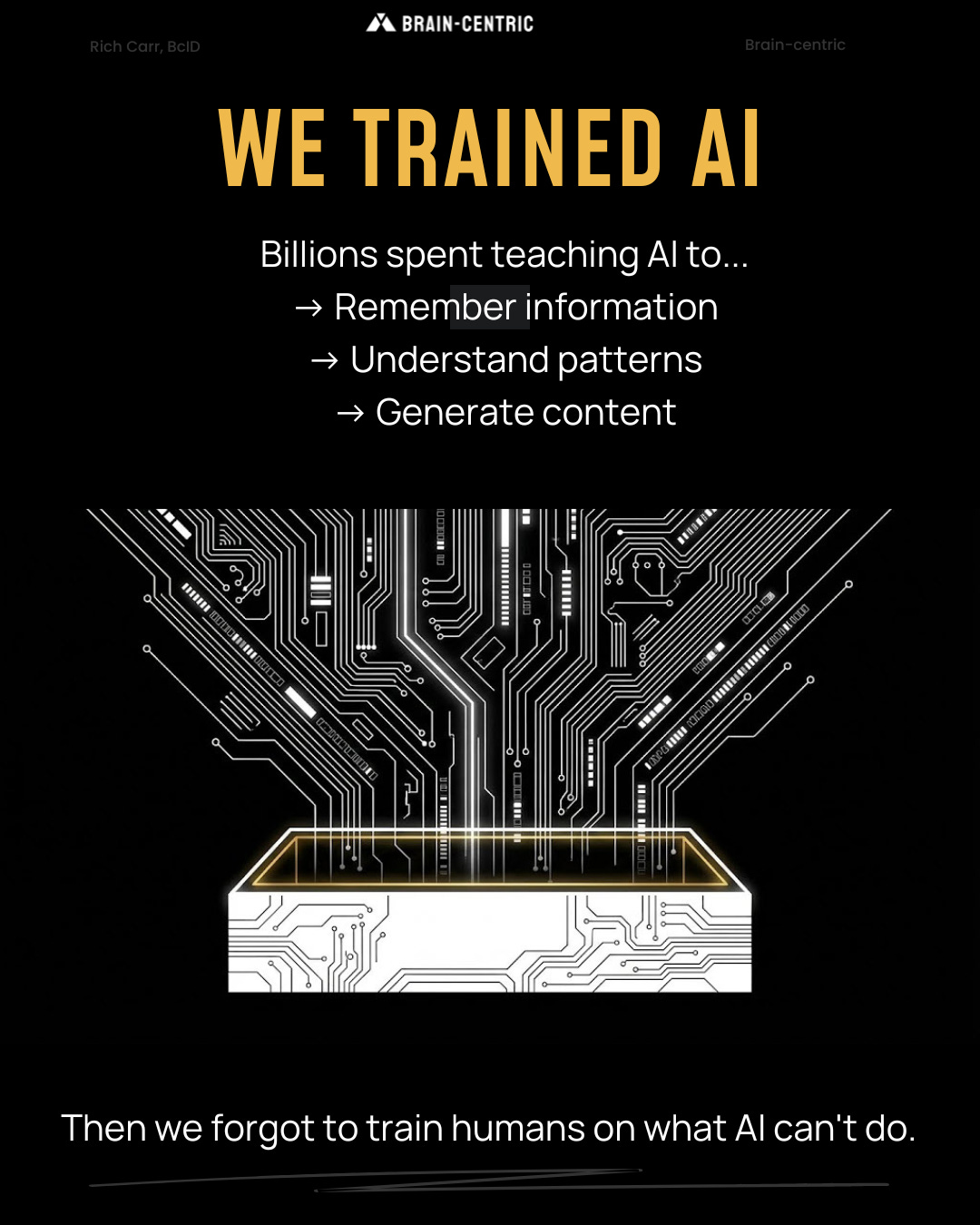
We Trained AI
Billions invested. Years of development. Massive computational resources.
Teaching AI to remember everything, understand patterns, and generate content at speed.
It worked. AI is exceptional at lower-order thinking.
But we forgot something critical: Lower-order thinking alone doesn’t create adoption. It produces content that gets ignored.
Generation without preparation is just expensive noise.

Levels 1-3: AI’s Domain
Level 1 - Remember
AI recalls vast amounts of information instantly. Perfect memory (with one flaw we’ll get to).
Level 2 - Understand
AI comprehends patterns, relationships, meaning in data. Processes language brilliantly.
Level 3 - Apply
AI uses frameworks to generate content, create presentations, optimize messaging.
This is what AI does better than humans. Faster. More consistent. More comprehensive.
Don’t compete here. You’ll lose.
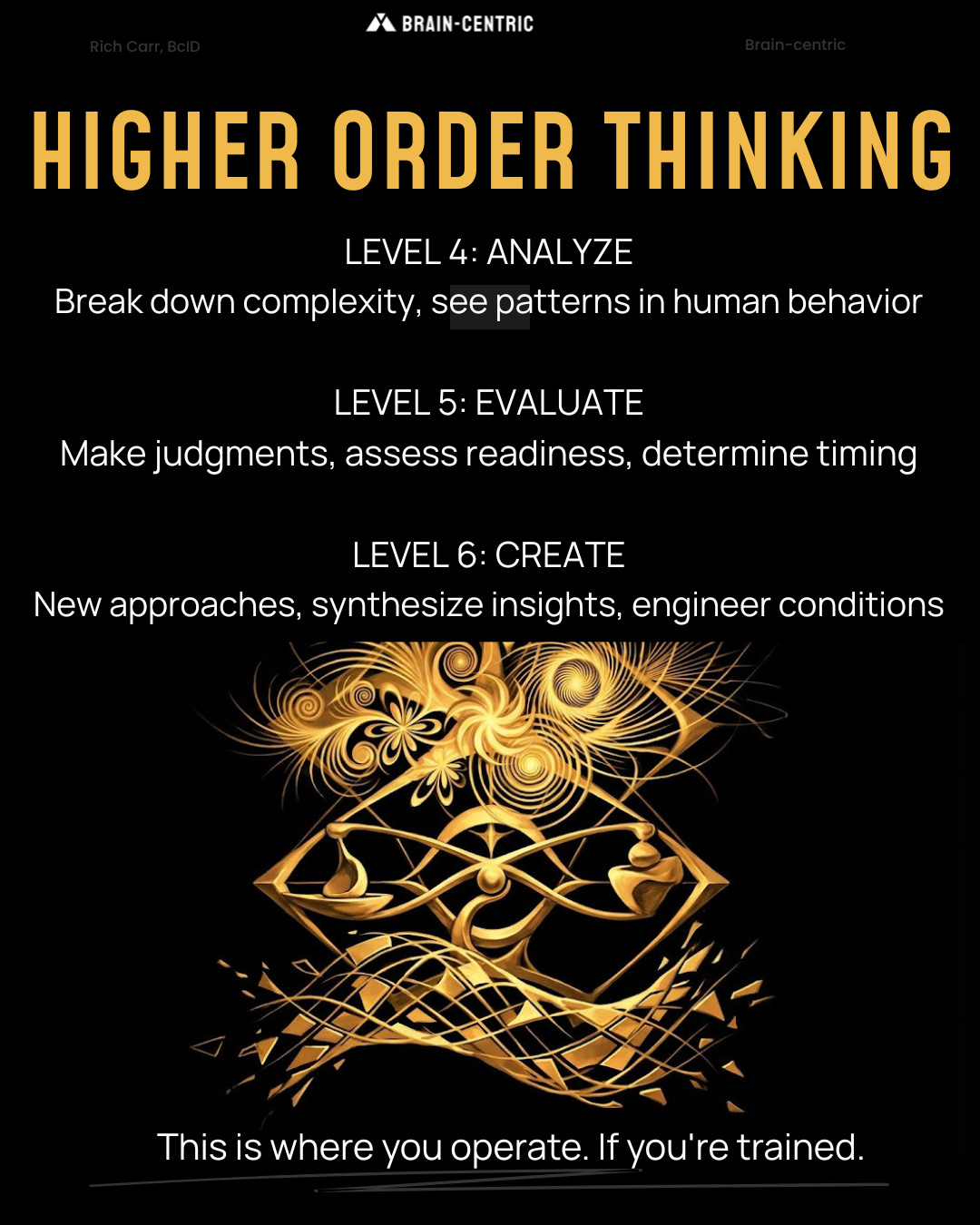
Levels 4-6: Your Domain
Level 4 - Analyze
You break down human complexity AI can’t see. Room dynamics. Political undercurrents. Emotional states. Identity boundaries.
Level 5 - Evaluate
You make judgments AI can’t make. Is this person ready? Is timing right? Will this land in their culture? What’s the real priority beneath the stated one?
Level 6 - Create
You engineer psychological conditions. Safety before content. Curiosity before conclusions. Voluntary adoption, not compliance.
This is where you operate. If you’re trained.
Most people aren’t.
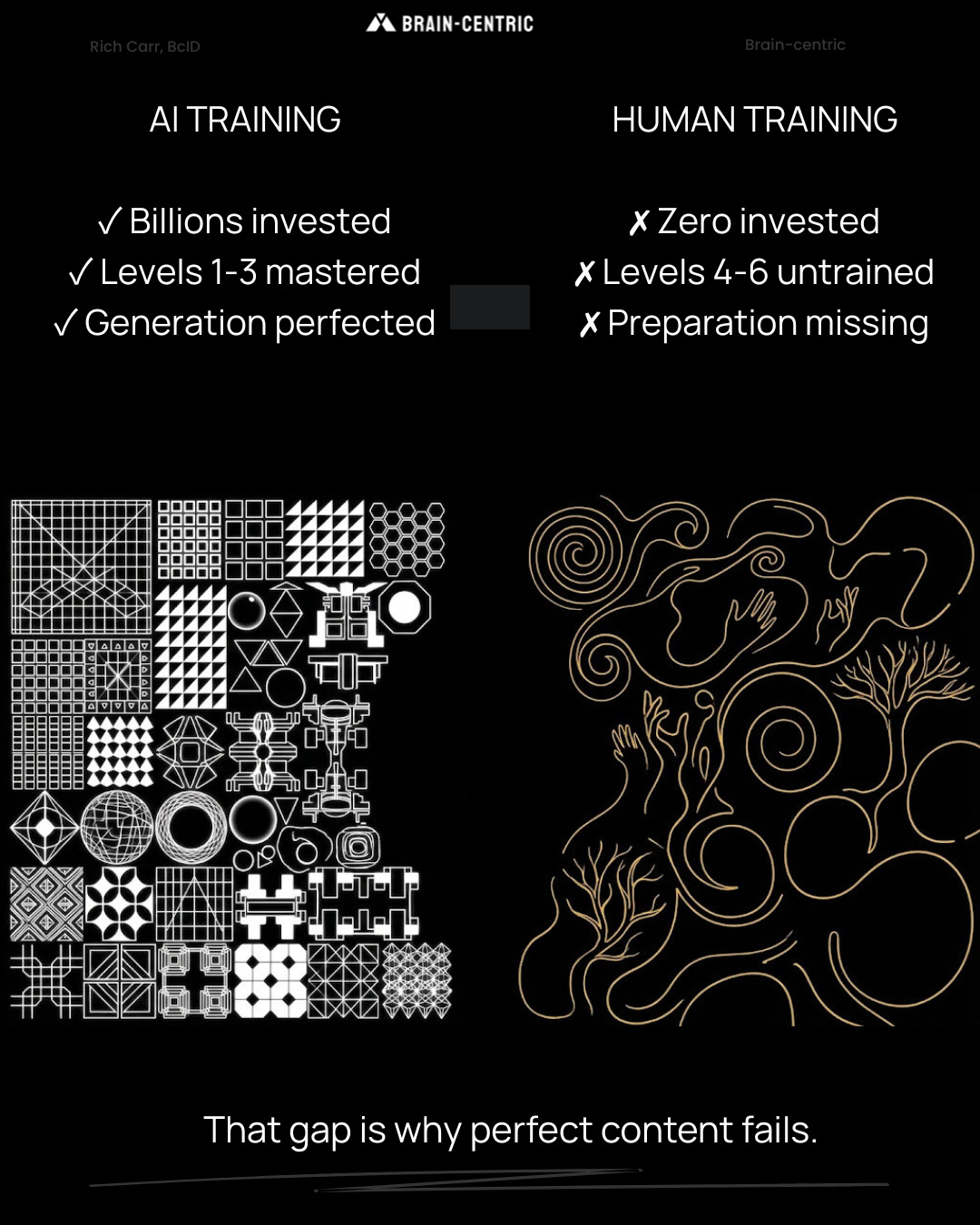
The Gap
Left side: AI generating perfectly. Complete. Optimized. Fast.
Right side: Humans preparing inconsistently. Accidental. Hoping instincts kick in.
That space between them? That’s where $2.4M in training investment disappears annually.
AI handles generation (levels 1-3) with precision.
You handle preparation (levels 4-6) with... hope?
Only one side got trained. That’s the gap.

What AI Will Never Do
Read a room’s energy before speaking.
Sense when someone’s in fight-or-flight mode.
Feel when timing is wrong even if logic says “now.”
Navigate the invisible political dynamics that determine adoption.
Create the psychological safety that keeps prefrontal cortex engaged.
Honor identity boundaries while advancing ideas.
These aren’t soft skills. These are advanced human cognitive processing capabilities that require being present with other humans.
Levels 4-6. Where AI fundamentally cannot operate.
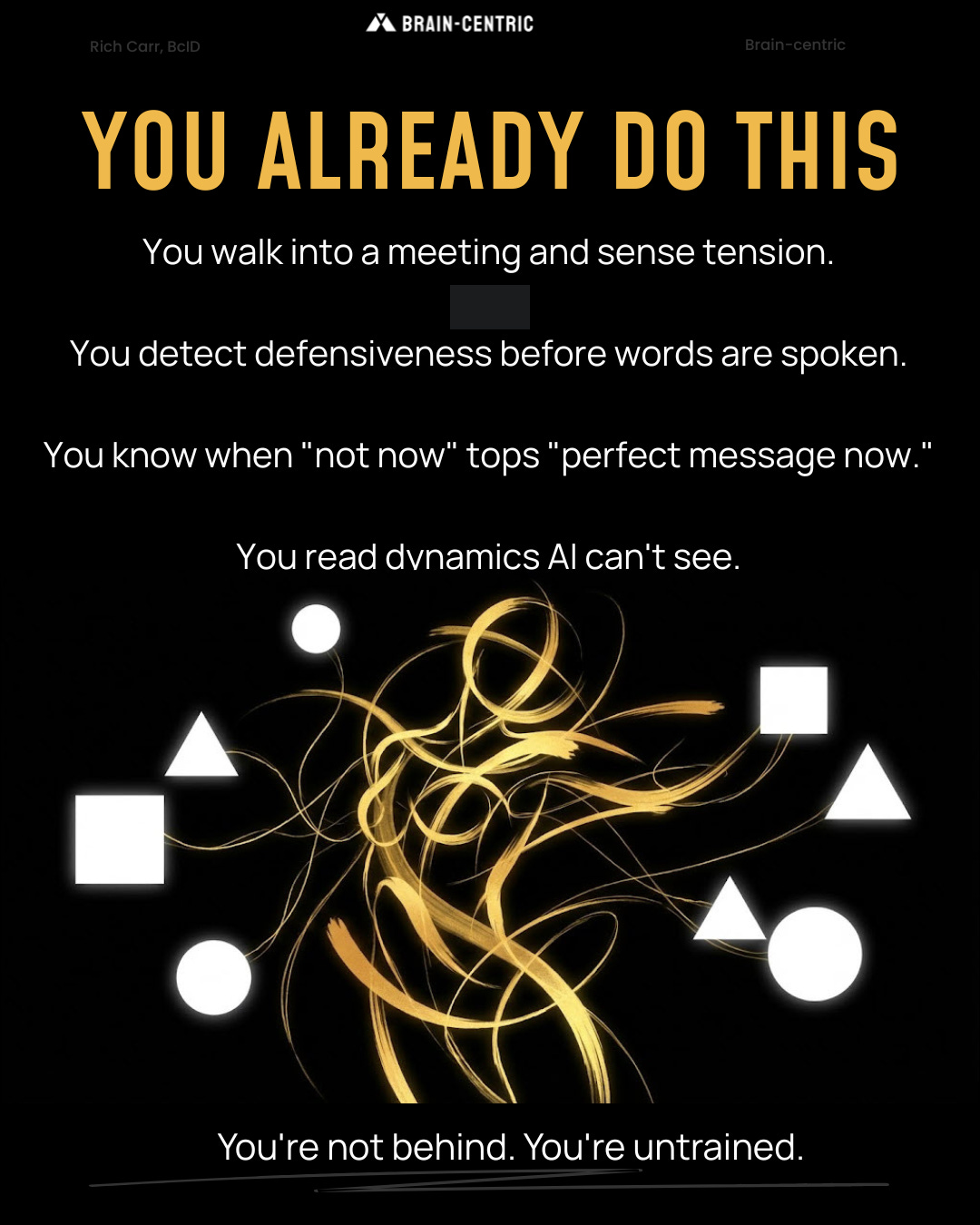
You Already Have This
You walk into a meeting and within seconds you sense: “This room is tense.”
AI has zero access to this information.
You start to pitch an idea and notice body language shift - defensiveness rising. You adapt in real-time.
AI sticks to script.
You’re about to send an important email and something feels off about timing. You wait. Tomorrow morning will land better.
AI sends immediately.
You already operate at levels 4-6. You just do it accidentally instead of systematically.
That’s not a limitation. That’s untrained capability.
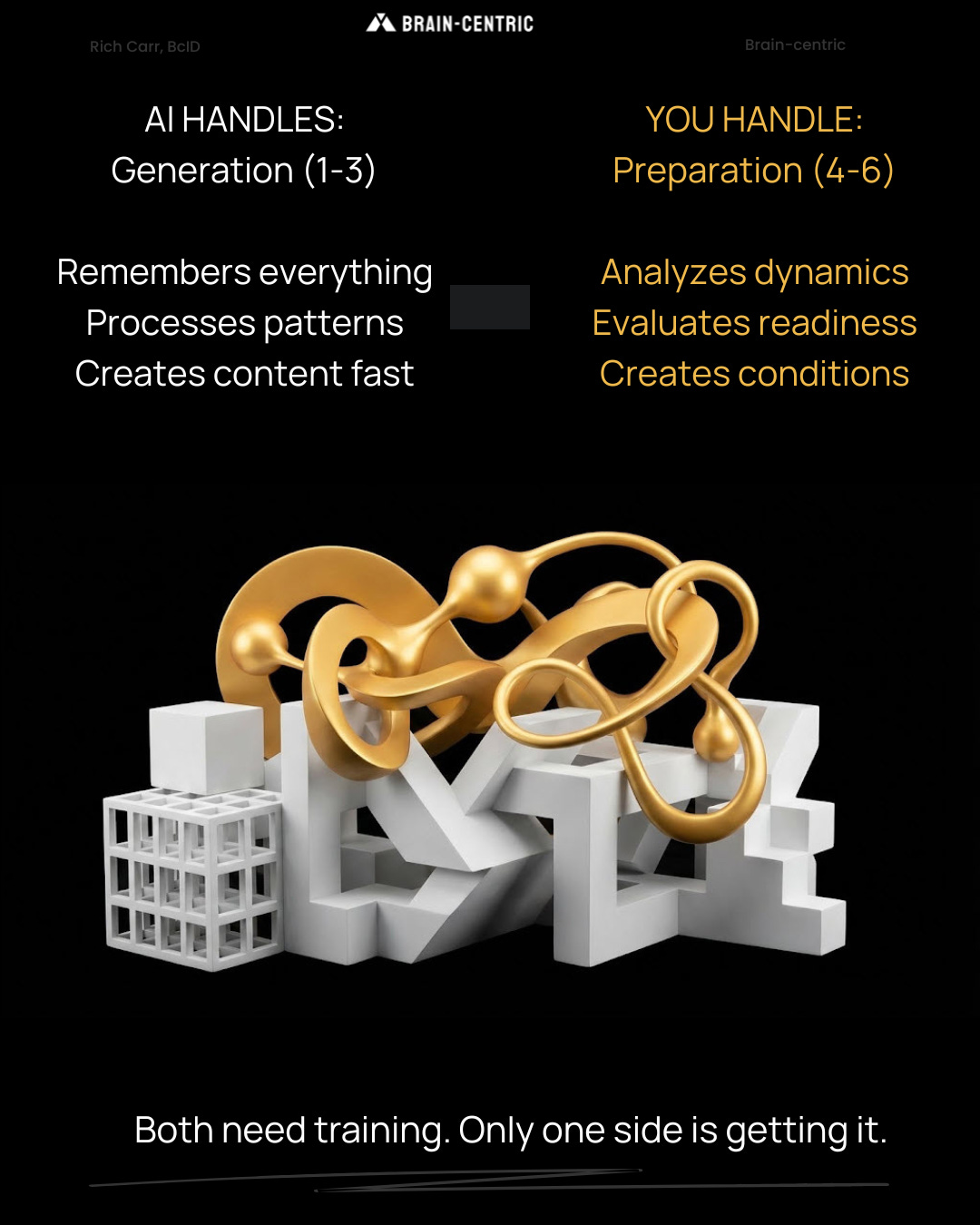
The Real Division of Labor
AI = Your lower-order cognitive assistant
Remembers everything (with context gaps)
Processes patterns at speed
Generates content brilliantly
You = Your higher-order cognitive architect
Analyzes dynamics AI can’t detect
Evaluates readiness AI can’t sense
Creates conditions AI can’t engineer
Neither works optimally without the other.
AI without preparation = ignored content. Preparation without AI = slow execution.
Both trained = unprecedented leverage.
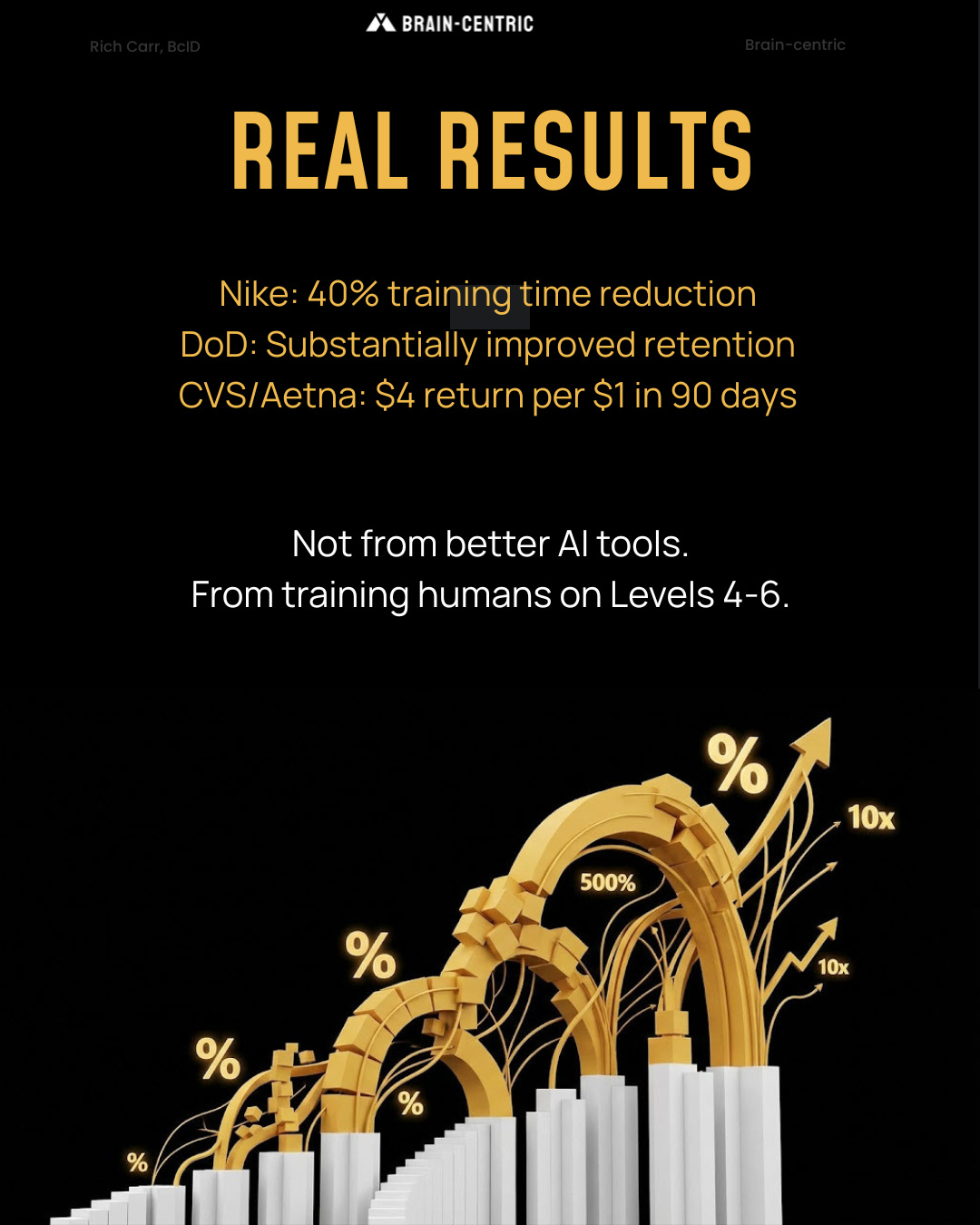
Fortune 100 Results
Nike: 40% training time reduction
Department of Defense: Substantially improved retention
Fortune 500 companies: $4 return per $1 invested within 90 days
None of this came from better AI tools.
All of it came from training humans on levels 4-6 frameworks:
Cognitive Glide Path (preparation before speaking)
Greenhousing (psychological safety design)
Challenge Wheel (multi-lobe cognitive engagement)
Strategic Surprise (attention management)
Nested Egg (memory architecture)
They trained the human side. Results followed.
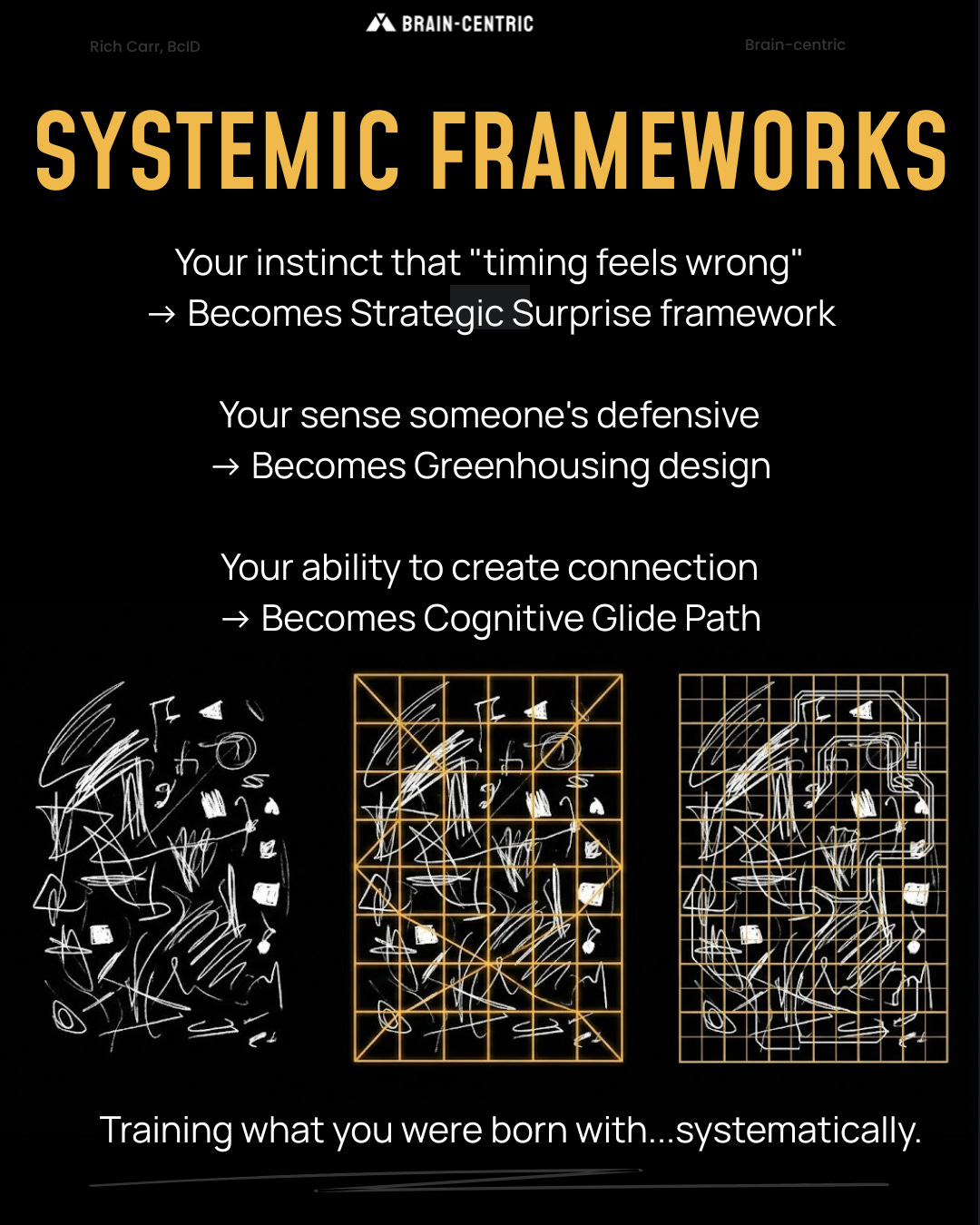
What Training Actually Means
Left:
Intuition without system. Random success. “Sometimes I nail it, sometimes I don’t.”
Center:
Frameworks emerging. Structure around instinct.
Right:
Systematic capability. Repeatable results. “I know exactly how to prepare minds.”
Training doesn’t teach you foreign skills.
It gives you frameworks that make what you naturally sense systematic.
You already detect defensiveness. Training teaches you to design it out before speaking.
You already sense timing. Training gives you attention science so you know exactly when minds are ready.
You already create connection. Training shows you how to engineer it instead of hoping for it.
The Question
Are you training levels 4-6?
Because generation is free now. AI proved that.
Preparation is priceless. Fortune 100 ROI proved that.
Content without cognitive preparation gets ignored.
Perfect data without psychological safety creates resistance.
Optimized messaging without evaluation of readiness fails.
Lower-order thinking is automated. Higher-order thinking is your competitive advantage.
If you train it.
The Brain-centric System
This is what it looks like when both sides are trained.
AI handles levels 1-3:
Generation, speed, optimization, scale.
You handle levels 4-6:
Analysis, evaluation, creation, adoption engineering.
Together: Measurable ROI. Faster results. Higher retention. Voluntary adoption instead of compliance.
Not someday. Not theoretical.
Right now. Companies doing this are delivering 40% time reductions and 4:1 returns in 90 days.
While everyone else learns better prompts, they’re training the thinking that makes prompts valuable.
You’re Not Behind. You’re Untrained.
There’s a difference.
AI got billions in training investment for levels 1-3.
You got zero for levels 4-6.
That imbalance created the gap. The gap created the failure rate. The failure rate created the panic.
But here’s what nobody’s saying clearly enough:
You already have the valuable capabilities. You sense dynamics. You read timing. You detect safety. You create conditions.
You’re just using them accidentally instead of systematically.
Now in our eighth year, Brain-centric teaches the frameworks that make your natural higher-order thinking repeatable and scalable.
Not theory. Fortune 100-validated frameworks that deliver measurable results in 90 days.
The BcID Certification launches January 16, 2026. Fourteen weeks of training what AI cannot replicate.
You’re not competing with AI on generation.
You’re training the preparation that makes AI valuable.
[Learn more about BcID Certification →]
P.S. If these visuals helped clarify where you actually operate versus where AI operates, share this with someone who’s trying to compete at the wrong levels. The gap between trained and untrained is the difference between getting ignored and getting $4 return per $1 in 90 days.
What lands most for me is the idea that the “gap” isn’t about people being behind, it’s about them being untrained in analyze/evaluate/create thinking, especially in real human contexts like safety, readiness, and culture. Really like the visuals too!
It's time to take the books of the bookshelf, dust them off, and start using the information.