

The Six Things AI Will Never See (And Why They're Your Future)
What "reading the room" actually means in your brain, and why it's the last skill machines can't steal

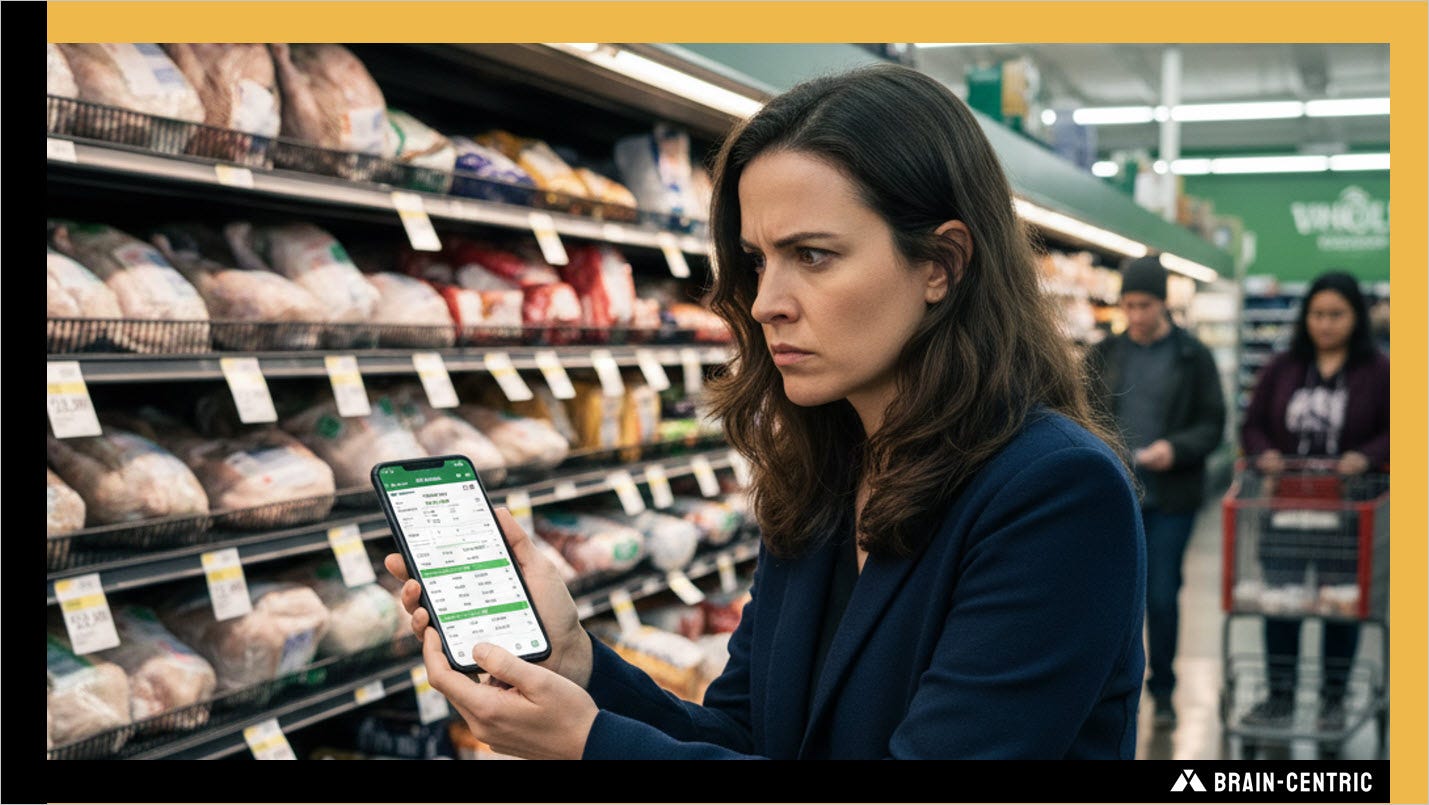
Mia stood in the frozen turkey aisle at Whole Foods, staring at her phone like it held the meaning of life.
It was the Tuesday before Thanksgiving. The store was a zoo. Shopping carts collided at intersections. A dancing Yam was handing out samples of marshmallow fluff in the vegetable department. The overhead speakers were playing something that might have been Radiohead but sounded like someone strangling a saxophone. Intercom announcements interrupted it occasionally with calls for “clean up in dairy” and “checker to the front.”
Sam walked up beside her, picked up a twenty-pound bird, and put it in his cart without hesitation.
“How do you do that?” Mia asked.
“Do what?”
“Just... decide. I’ve been standing here for fifteen minutes with a decision matrix my AI assistant built. It factors in price per pound, organic vs. conventional, heritage breed considerations, environmental impact scores, and optimal cooking time based on guest count and oven efficiency.”
Sam looked at her phone. Then at the frozen turkeys. Then back at her.
“How many people are you feeding?”
“Eight.”
“Get that one.” He pointed to a sixteen-pounder.
“But the data…”
“The data doesn’t know your Aunt Daria’s going to bring three sides you didn’t plan for. Or that your brother’s kids don’t actually eat turkey. Or that you’re going to be exhausted by Thursday morning and need something simple.”
Mia stared at him. “How did you…”
“I’ve met your family,” Sam said, grabbing the turkey and putting it in her cart. “And I’ve watched you host Thanksgiving twice. You don’t need more information. You need permission to stop researching and start cooking.”
She opened her mouth to argue. Then closed it. The turkey was in her cart. The decision was made. And she felt... lighter.
Sam was whistling ‘Creep’ while navigating his cart past the stuffing end cap. He stared at the egg nogg, but kept walking.
“That’s the thing about you,” she said as they walked toward checkout. “You do this thing where people just... go along with what you suggest. Even when they have no reason to. What is that?”
Sam smiled. “You want to know?”
“Obviously.”
“Okay. But you have to watch carefully. Because what I’m about to show you, most people never see it.”
Later, Mia would remember what happened next as the moment everything changed.
They were trying to navigate the aisles as a woman tried to convince her husband that they needed a twenty-five-pound turkey for four people…backing up the flow of foodies. The husband looked exhausted. Defensive. His arms were crossed. He kept saying, “We always buy too much. We always throw half of it away.”
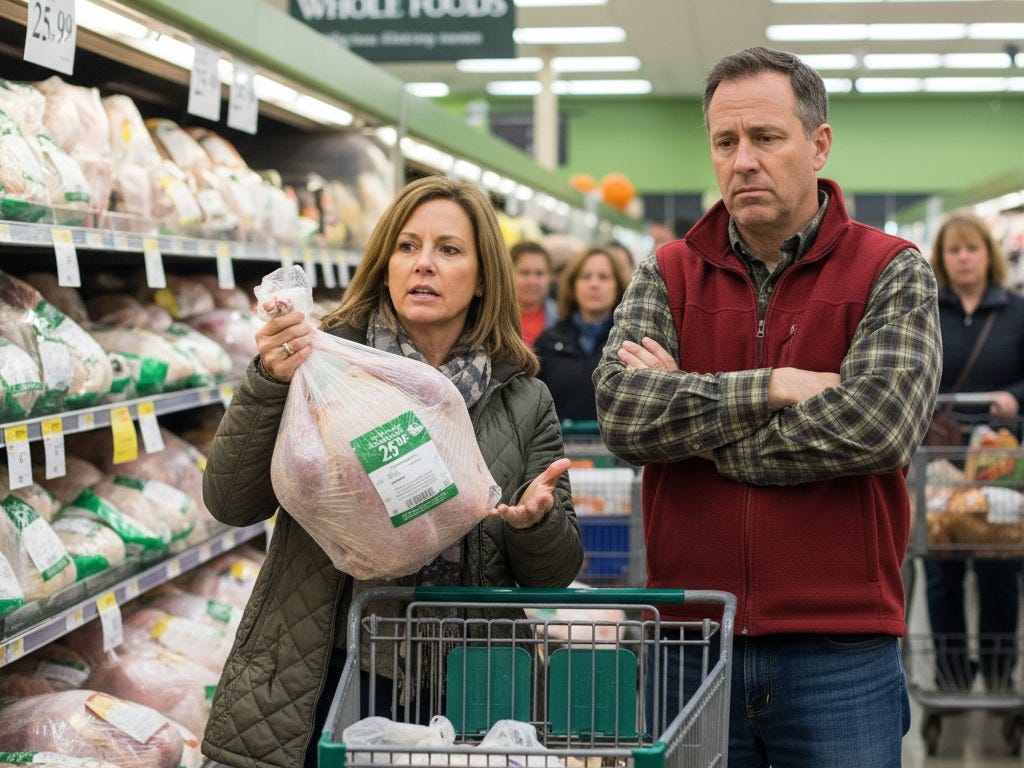
The wife wasn’t hearing him. She was doubling down. “But Hristo, what if people drop by? What if…”
Sam leaned in slightly. Not intrusive. Just present.
“Excuse me,” he said gently and with a relating grin. “I couldn’t help overhearing. My mom does the same thing…she’s terrified of running out of food. Drove my dad crazy for years.”
The husband’s posture shifted. Just barely. His arms uncrossed a fraction.
“What changed?” he asked.
“She realized she wasn’t actually worried about the food. She was worried about looking like a bad host. Once she named that, she could deal with the real problem, which was figuring out what would make her feel like a good host, not what her brain was catastrophizing about.”
The wife went quiet.
Thirty seconds later, they were talking about realistic portions. Ninety seconds after that, they’d picked a smaller bird and were laughing about it.
Mia watched the whole thing with her mouth slightly open.
“What just happened?” she asked when they walked away.
“I read the room,” Sam said.
“That’s not reading. That’s…what is that?”
Sam looked at her. “You really want to know?”
“Yes.”
“Then come with me. We need coffee. And I need to show you six things you’ve been missing your entire life.”
They sat at a cozy wooden table at the High Cotton Coffee Company. Mia had her laptop open, probably reflexively…she’d been vibecoding. Sam had a cup of Signature Blend and half-unfolded a large napkin.
“So here’s what you missed back there,” Sam said, pulling out a pen. “That husband? His arms were crossed when we walked up. That’s not stubbornness. That’s defense. His brain was protecting itself.”
“From what?”
“From being wrong. From losing the argument. From feeling like he doesn’t get a say in his own Thanksgiving. From starting an argument, I dunno. When people’s brains feel threatened, they shut down. Doesn’t matter how good your argument is. The brain won’t even process it.”
“So what did you do?”
“I gave him an out. I told a story about my mom that made his position feel normal, not stupid. Once his brain felt safe, he could actually think.”
Mia sat back. “That’s why I can’t convince my team about anything. I come in with all the data, all the research, and they just... resist. And I double down. Add more proof.”
“Which makes it worse.”
“Why?”
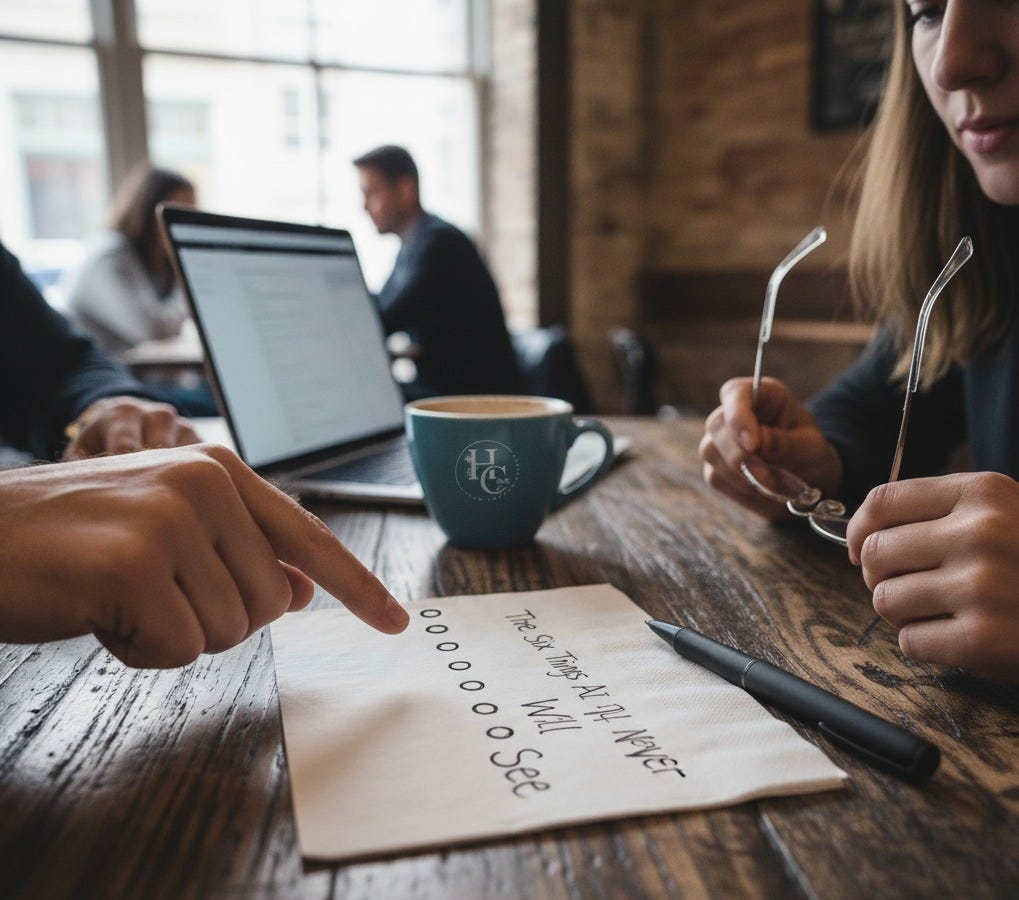
“Because you’re not reading what their brains are doing. You’re so focused on what you want to say that you’re missing what they’re actually able to hear.” Sam doodled a series of dots on the napkin. “There are six signals. Six moments when you can see someone’s brain either opening or closing to what you’re saying. The average person never learns to spot them. So they keep talking when they should stop. Or they stop when they should lean in. Or they push when they should pull back.”
“And you can see these signals?”
“Anyone can. Once you know what to look for.”
Mia looked at the napkin. Six dots. “Show me.”
“Okay,” Sam said. “Let me walk you through what happened in that grocery store. Because I was watching six things happen at once, and each one told me exactly what to do next.”
The Six Signals
Signal 1: Emotional Readiness
“The first signal is whether their emotional state is even open to new information,” Sam explained, tapping the first dot on the napkin.
“The husband in the turkey aisle. His arms were crossed when we walked up. That’s not stubbornness. That’s protection. His brain was in a defensive state. If I’d offered advice about turkey sizes right then, he would’ve filtered everything I said through skepticism - probably would’ve bought the twenty-five-pounder just to prove his wife right.”
“So you asked about your mom.”
“Right. Because that let him discharge the frustration he was carrying. Once he heard that someone else’s family had the same problem - and that it wasn’t actually about the turkey - his brain shifted. He wasn’t defending anymore. He was searching for a solution.”
Mia thought about her last team meeting. Everyone had walked in with some version of arms crossed, tight jaw, guarded posture. She’d interpreted it as “they’re resistant to change.”
Sam saw it as “they’re not ready yet.”
“You have to read whether the brain is in receive mode or defend mode,” Sam said. “If it’s defending, nothing you say will land…no matter how good it is. Your job is to shift the emotional state first. Then you can communicate.”
The Signal: Watch for physical tension, closed posture, clipped responses, or eyes that don’t quite meet yours. The brain is protecting, not processing. You cannot influence a brain in defense mode.
Signal 2: Cognitive Friction Rising
“The second signal is when you can feel the room getting heavier,” Sam continued, tapping the second dot.
“I don’t understand.”
“You ever explain something to someone and watch their eyes glaze over? It’s subtle. They shift in their seat. They glance at their phone. Or - like you in the turkey aisle - they stare at a screen full of data and can’t make a decision.”
Mia winced. “That was cognitive overload?”
“Your brain was screaming ‘this is too much.’ But you thought the answer was more analysis. More data points. If I’d walked up and added my own turkey-buying framework, your brain would’ve shut down completely. What you needed was someone to subtract…not add.”
“So you just told me to get the sixteen-pounder.”
“I gave you one piece of information your brain could actually use: your family’s patterns. Everything else was noise.”
Mia thought about the forty-slide presentation she’d given her team last month. Comprehensive. Covering every angle. Three people had left for ‘urgent calls’ halfway through.
“They weren’t leaving because they didn’t care,” Sam said when she told him. “They were leaving because their brains couldn’t carry what you were asking them to carry. And instead of simplifying, you kept adding.”
The Signal: Watch for small physical shifts…eyes unfocusing, postural adjustments, subtle fidgeting, checking phones, or paralysis in decision-making. The brain is rejecting complexity. Stop adding. Start subtracting.
Signal 3: Identity Threat Activation
“Here’s the one most people never see,” Sam said, leaning forward. “Watch for when someone’s identity feels threatened.”
“How do you see that?”
“Defensiveness. But not the obvious kind. The subtle kind. The wife in line, when I first mentioned ‘my mom does the same thing,’ I watched her face. She could’ve gotten defensive. Could’ve said, ‘I’m not like your mom’ or ‘That’s different.’ But I framed it as care, not criticism. So her brain didn’t activate threat.”
“What if you hadn’t done that?”
“She would’ve dug in. Defended the twenty-five-pound turkey even harder. Because if she admitted I was right, it would mean she was being irrational. Or that she’s a people-pleaser. Or that she doesn’t trust her own judgment. The brain will reject a good idea if accepting it threatens the person’s sense of self.”
Mia sat with that. She’d heard phrases like “We tried that before” and “That’s not how we do things here” dozens of times from her team. She’d always interpreted them as objections to overcome. She’d never considered they were identity protection.
“So what do you do?”
“You remove the threat. You make it safe for them to adopt your idea without admitting they were wrong. You say things like, ‘Most teams don’t spot this until it becomes urgent,’ or ‘This approach just became viable…there’s no way you could have known last quarter.’”
“You give them an out.”
“I give their brain permission to change without losing face. That’s very different from overcoming an objection.”
The Signal: Listen for deflection phrases or past-tense justifications. The brain is protecting identity, not evaluating your idea. Create safety before you create agreement.
Signal 4: Prediction Error Moments
“This one’s my favorite,” Sam said, smiling and tapping the fourth dot. “Because this is when you know you’ve got them.”
“When?”
“When they stop. When their face shifts. When they say something like, ‘Wait—really?’ or ‘I didn’t know that.’ That’s a prediction error. Their brain expected one thing and got another. And in that moment, the brain opens completely.”
“Why?”
“Because prediction errors force learning. The brain’s entire job is predicting what comes next. When that prediction fails, the brain has to rebuild its model. It has to pay attention. And if you deliver the right information in that moment - the exact moment when they’re ready - it sticks.”
Mia remembered the husband’s face when Sam said his mom worried about being a bad host. His whole expression had changed. He hadn’t expected that. The door opened.
“You can’t force prediction errors,” Sam said. “But you can create conditions where they’re more likely. You surface what they expect. Then you gently show them what they missed.”
The Signal: Watch for pauses, forward leans, facial shifts, or questions that indicate surprise. The brain just opened. This is your moment. Don’t waste it by talking too much.
Signal 5: Safety Collapse
“Now the dangerous one,” Sam said, tapping the fifth dot. “Safety collapse.”
“What’s that?”
“It’s when you feel the conversation shut down completely. Usually happens when someone feels cornered. You pushed too hard. You challenged them publicly. You made them look incompetent. The brain goes into full defense mode. And once that happens, you’ve lost. Not just the conversation. The relationship.”
Mia winced. She’d done this. She’d corrected her VP in a team meeting once - gently, she thought - about a technical misunderstanding. The VP had gone silent. The meeting ended soon after. They’d barely spoken since.
“Safety is everything,” Sam said. “The brain won’t adopt any idea if it feels unsafe. Doesn’t matter how good the idea is. Survival beats logic every time.”
“So how do you avoid it?”
“You watch. You notice when someone’s shoulders tense. When their voice gets quieter. When they stop making eye contact. When they suddenly agree with everything you say in that flat, done-with-this tone. Those are early warnings. If you see them, you back off immediately. You soften your language. You give them control. You make it clear they’re safe.”
“Even if it means losing the argument?”
“Especially then. Because if you win the argument and lose the safety, you lose everything. Watch the couple in the grocery store…I never challenged the wife directly. Never said she was wrong. I just created space for her to reconsider without feeling attacked.”
The Signal: Watch for sudden withdrawal - silence, minimal responses, tightened posture, loss of eye contact, or flat agreement without engagement. The brain feels threatened. Stop. Rebuild safety before you continue.
Signal 6: The Adoption Pause
“Last one,” Sam said, tapping the final dot. “And this is how you know you’ve actually influenced someone.”
“What is it?”
“The pause. The moment right after they understand. They stop talking. They look away…not because they’re disengaged, but because they’re processing. Their brain is running the model you just gave them. Testing it. Seeing if it fits their world.”
“And?”
“If you let that pause happen, if you don’t rush to fill the silence, they’ll come back to you with ownership. They’ll say something like, ‘So if we did this…’ or ‘That would mean…’ They’re completing your idea with their own thinking.”
“That’s when adoption happens.”
“Exactly. But most people panic during that pause. They think the silence means confusion, so they start explaining more. And when they do that, they interrupt the exact moment when the brain was about to adopt. After I told the couple about my mom, there was this pause. The wife looked down. Thought about it. Then she said, ‘Maybe the fourteen-pounder would be enough.’ She owned that decision. It was hers.”
Mia realized she’d never let a pause happen. Ever. She’d interpreted silence as failure. So she’d filled it with more explanation, more justification, more data.
“The pause is sacred,” Sam said. “If you see it, protect it. Let their brain work. Trust the process.”
The Signal: Watch for a quiet, inward pause - not confusion, but integration. The brain is adopting. Do not speak. Let ownership form naturally.
It was Thursday morning. The kitchen was chaos. Three burners going at once. Her sister was peeling potatoes. Her brother was arguing with his wife about whether stuffing should have raisins.
Mia’s Aunt Daria walked in holding two casserole dishes, neither of which they had discussed.
“I made my green bean casserole,” Daria announced. “And sweet potato surprise.”
Three months ago, Mia would’ve felt her chest tighten. She would’ve mentally recalculated portions. She would’ve worried about looking unprepared or - worse -ungrateful.
Instead, she watched Daria’s face. Saw the slight tension in her jaw. The way she held the dishes a little too carefully.
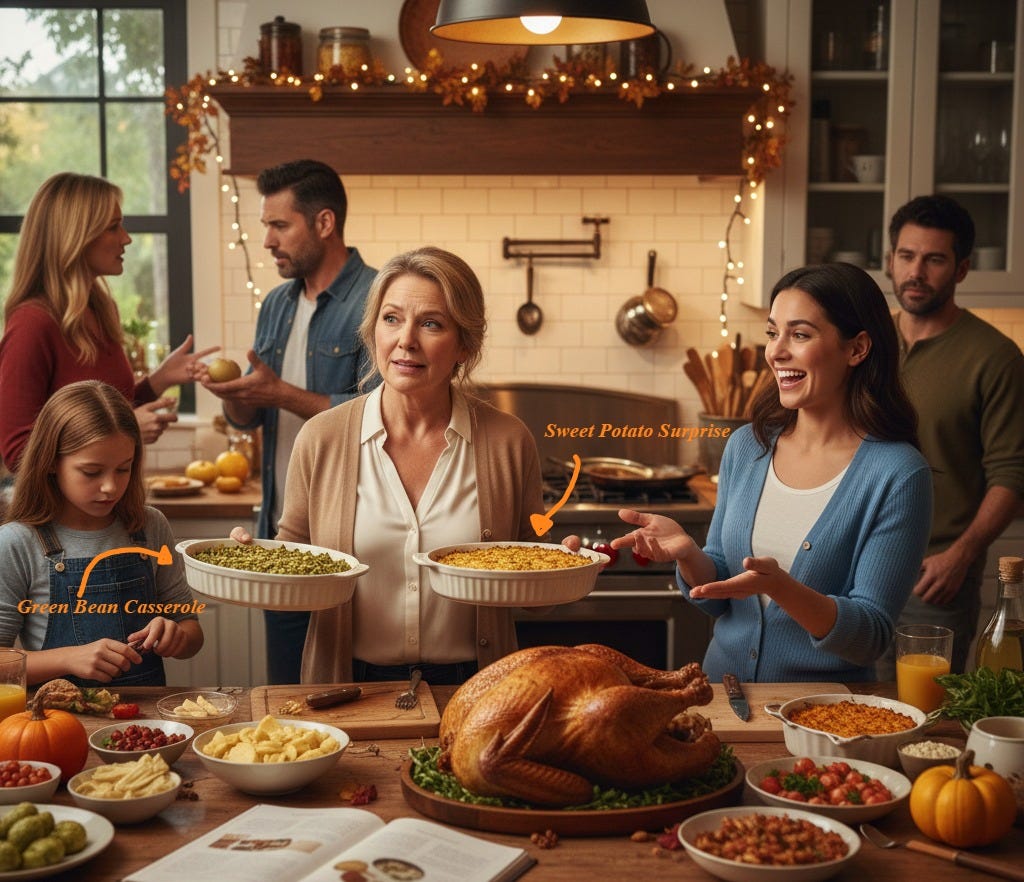
Signal 1: Emotional readiness.
Daria wasn’t offering. She was asking for permission to matter.
“Thank God you brought those,” Mia said. “I was worried we didn’t have enough sides.”
Daria’s shoulders dropped. “Really?”
“Really. You just saved Thanksgiving.”
And Daria smiled. A real smile. Not the tight, anxious one she usually wore at family gatherings.
Later, during dinner, Mia’s brother took over the conversation. Talking about work. His achievements. How busy he’d been. She watched the rest of the table. Saw eyes glazing over.
Signal 2: Cognitive friction rising.
She waited for the natural pause. Then said, “Csabi, tell us about Karen’s dance recital. I heard she killed it.”
His daughter lit up. The conversation shifted. The table relaxed.
After dinner, when everyone was deciding whether to stay or leave, Mia felt that familiar urge to over-plan. To suggest activities. To fill the space.
Instead, she let the pause happen.
Signal 6: The adoption pause.
And her mom said, “Why don’t we all take a walk? Work off some of this food.”
Everyone agreed. Not because Mia suggested it. Because her mom discovered the idea and owned it.
That night, after everyone left, Mia sat on her couch with a glass of wine and thought about Sam. About the six signals. About how she’d been bulldozing through life with data and conviction, missing what was actually happening in the people around her.
She pulled out her phone and texted him: I saw all six today. Thank you.
His reply came back thirty seconds later: That’s the advantage no AI will ever have.
The next morning, Mia was back at work. She had a team meeting at nine. The kind where she usually came armed with slides, data, analysis…everything she needed to prove her point.
This time, she came with a single question and a napkin with six dots.
She watched. Really watched.
When Joe crossed his arms during her opening, she didn’t push harder. She asked him what concerned him most.
When Emily’s eyes started glazing over during the technical explanation, she stopped mid-sentence and simplified.
When David said, “We tried something like this last year,” she didn’t argue. She said, “Most teams don’t have visibility into what’s changed in the last six months. We didn’t either until recently.”
When Ana’s face shifted - that moment of surprise when the prediction broke - Mia leaned in with just one clear model.
When she felt the conversation getting tense, she pulled back.
And when the silence came, that beautiful, uncertain pause, she let it breathe.
Then Ana said, “So if we implemented this in phases, we could actually reduce risk while proving value.”
“Exactly,” Mia said.
And stopped talking.
The team adopted the plan. Not because she convinced them. Because she prepared them to convince themselves.
That afternoon, she thought about the turkey aisle. About Sam. About how AI could’ve generated perfect talking points for that team meeting. Could’ve created data visualizations. Could’ve simulated objections and responses.
But AI would’ve missed Joe’s arms crossing…
→ It would’ve missed the cognitive load rising in Emily’s unfocused eyes.
→ It would’ve missed the identity threat hiding behind David’s past-tense deflection.
→ It would’ve missed the prediction error that opened Ana’s mind.
→ It would’ve missed the safety almost collapsing.
And it would’ve filled the adoption pause with more explanation, killing the exact moment when influence became ownership.
These six signals live in the space between words. In micro-expressions. In the timing of silence. In the weight of a room.
You can’t code for weight.
You can’t train a model to feel when someone’s brain shifts from defense to openness.
You can’t simulate the intuition that says “stop talking now.”
That’s human work.
That’s your work.
Back in that frozen turkey aisle, Sam wasn’t just deciding faster than Mia’s AI assistant. He was reading signals the AI couldn’t even detect existed.
→ AI sees data points. Humans see brain states.
→ AI optimizes for completeness. Humans optimize for readiness.
→ AI can tell you what to say. Only you can tell when to stop saying it.
These six signals are way more than just practical skills. They’re your competitive moat. Your hedge against obsolescence. Your proof that the most valuable work isn’t generating information…it’s preparing minds to receive it.
As AI improves at creating content, these signals become more valuable. The bottleneck isn’t content anymore. It’s human adoption. And adoption happens in the invisible space these six signals occupy.
The Six Signals You Own…
1. Emotional Readiness – Is the brain in receive mode or defend mode?
2. Cognitive Friction Rising – Is complexity overwhelming processing capacity?
3. Identity Threat Activation – Is the brain protecting self-image over evaluating truth?
4. Prediction Error Moments – Was their expectation surprised in a way that opens learning?
5. Safety Collapse – Is the brain shutting down completely due to perceived threat?
6. The Adoption Pause – Is their brain integrating the model right now?
While everyone else is asking “How do I compete with AI?” you’re building the one skill AI fundamentally cannot replicate: reading the invisible signals that determine whether a human brain says yes or no.
This isn’t a temporary advantage. This is permanent asymmetry.
→ AI will get better at analysis. You’ll get better at sensing.
→ AI will get better at arguments. You’ll get better at timing.
→ AI will get better at content. You’ll get better at adoption.
And in every room, every meeting, every conversation, you’ll see what the machines never will.
Start today. Right now.
Pick your next conversation. Your next meeting. Your next presentation.
Don’t just prepare what you’ll say.
Prepare what you’ll watch for:
→ Watch for the arms that cross and uncross.
→ Watch for the eyes that glaze when load rises.
→ Watch for the deflections that protect identity.
→ Watch for the face that shifts when prediction breaks.
→ Watch for the withdrawal when safety collapses.
→ Watch for the sacred pause when their brain adopts.
You’ll start seeing what you couldn’t see before.
And once you see it, you’ll realize: this isn’t just an advantage.
This is freedom.
The freedom to influence without manipulation.
The freedom to lead without force.
The freedom to know that no matter how sophisticated the machines become, they will never replace the human who can read a room.
These six signals are your future.
Learn them. Practice them. Master them.
Because the professionals who own the AI age won’t be the ones who generate the most.
They’ll be the ones who see the most.
And now you know what to look for.
---
Which of the six signals did you miss most recently? Which one will you start watching for tomorrow?
P.S. The sixteen-pound turkey was perfect. Aunt Daria’s sides fit beautifully. And nobody had to consult an AI to figure that out.
P.P.S. All the names used in this story are real Substackers whose Notes & Newsletters resonate with me often, so this Newsletter is an homage to their work. Thank you:
Daria Cupareanu Mia Kiraki 🎭 Sam Illingworth Joe Mills Csabi Berger Karen Spinner The Real Raw Ana Calin Hristo Butchvarov
This story made my Sunday. I was about to comment a joke and be like "LOL, I'm definitely not like your Mia" and then I kept reading and reading and reading...
And then I saw the "P.P.S. All the names used in this story are real Substackers"... 😅
Loved all of it and the reality of AI + humans. Brilliant work!
Also... Hi Aunt Daria 🤣
Inherently human and being human. As speakers we've all noticed the arms crossed and audience members disengaged and felt helpless. We are so proud of our presentation and it may be great. Then you run into human emotions. That's where we can now focus to increase our skills. Yes, let AI gather the data, create the pictures for presentations. AI is freeing us to get down to the core of changing minds and hearts of being more human. Great framework Rich.