

The Substack Algorithm Isn't Your Enemy...Your Brain Is
One neural principle beats consistency.

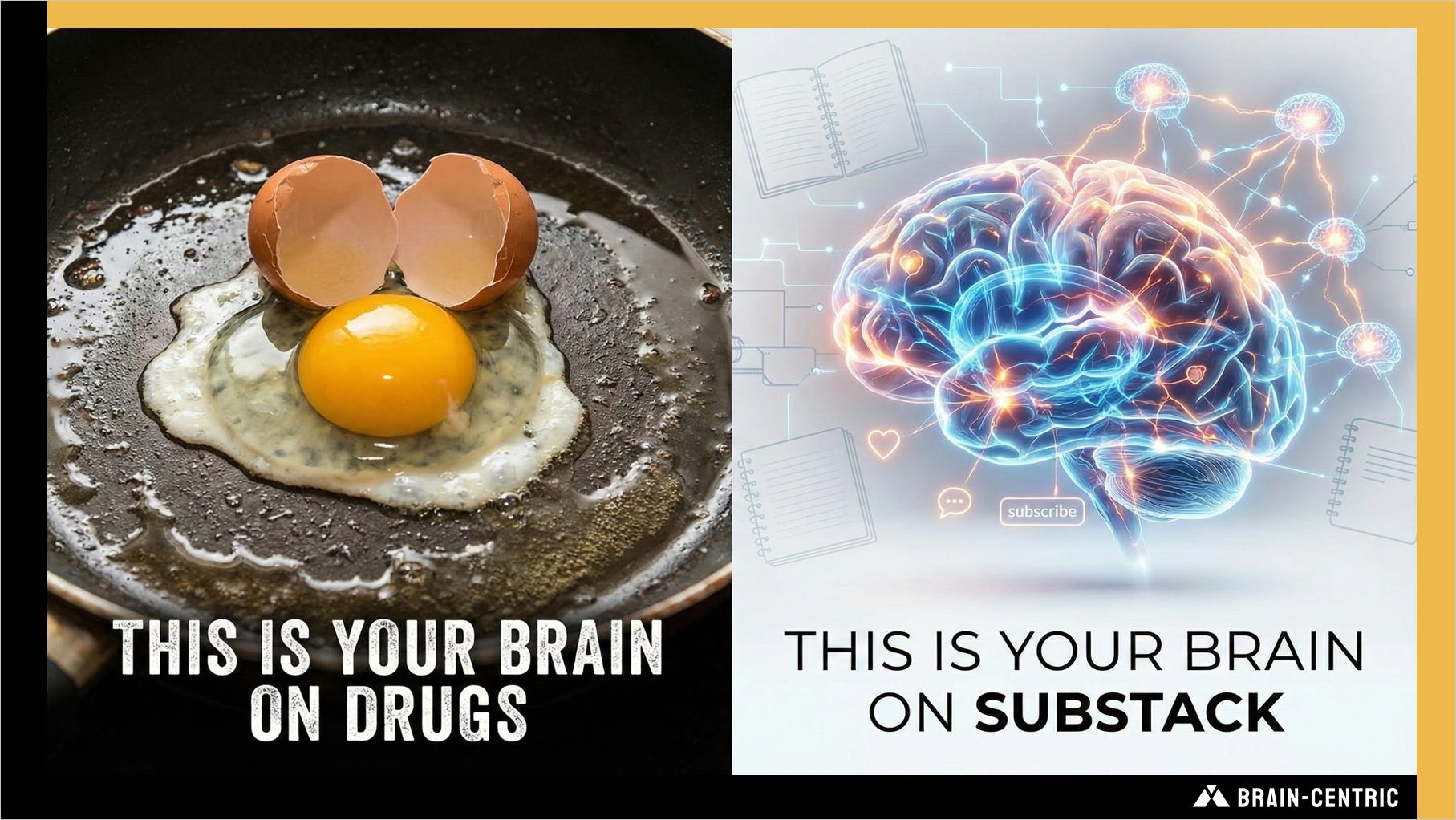
I was out for a walk, thinking about ‘Substack things,’ when I recalled the classic public service announcement “This is your brain on drugs.” I’m not sure why, but I giggled as I segued back to my original thoughts and said aloud, “This is your brain on Substack.”
Naturally, I wanted to research why the human brain loves Substack, learn from it, and let my subscribers know how this platform works. It turns out the neural activity doesn’t look like what you’ve been told. The algorithm doesn’t reward what you’ve been optimizing. Understanding why changes everything about how you do that thing you do.
Here’s the first thing to unlearn: your subscriber count is not a ranking in a competition. When you compare your 487 subscribers to someone else’s 12,000, your brain does what it’s wired to do. It calculates scarcity, triggers status anxiety, and makes you feel like you’re losing. That’s your amygdala lying to you.
Substack’s algorithm doesn’t see it that way. It doesn’t rank writers by subscriber count. It matches readers with writers. Which means your 487 subscribers are not 487 data points in a hierarchy. They are 487 people whose brains have already decided you matter enough to let you into their inbox. That’s not a small number. That’s a signal.
The algorithm learns from that signal. Every time one of your readers opens your post, replies, reshares, or recommends you, that’s information. That’s the system understanding who you serve and how to find more people like them. Scale doesn’t matter yet. Signal does.
I’ve been studying learning systems for forty years. How information moves through networks. How thoughts turn into words on a page that resonate. How brains decide to stay versus how brains decide to leave. What I’m about to tell you isn’t theory. It’s data from Substack’s head of machine learning, Mike Cohen. It’s behavior patterns from writers who’ve grown from zero to thousands of subscribers. And it’s neuroscience that explains why it all works.
Here’s the thing nobody wants to hear: the algorithm on Substack isn’t trying to hack your brain. It’s trying to match your brain with readers who think like you do.
That changes everything.
Here’s the crazy part…Substack’s algorithm is actually honest. Substack’s business model is the opposite of Meta, TikTok, and LinkedIn. Those platforms make money from advertising. That means their algorithms are designed to keep you on the platform, scrolling, feeding you the dopamine hit of outrage or comparison or novelty. The algorithm serves the advertiser’s master, not yours.
So, if you’ve jumped ship off other platforms because you haven’t caught whatever you’ve been chasing, hopping into Substack is actually turning your back on the platforms trying to put a steel ring through your nose. “Attica! Attica!”
Substack makes money when readers subscribe. That means their algorithm serves subscriptions and paid conversions…not engagement or time-on-platform. Mike Cohen was explicit about this when he explained their architecture to creators. The goal is simple: help readers discover publications they’ll pay for, and help creators connect with readers who genuinely want their work.
This is what an honest algorithm looks like.
This is where the neuroscience matters. When a reader’s brain is on Instagram, it’s being manipulated by what we call “intermittent variable reward” - the exact mechanism that makes slot machines addictive. Your nucleus accumbens (the reward center) fires when you might get a hit, not when you actually get one. It keeps you pulling the lever.
But on Substack? The algorithm is showing you things your prefrontal cortex - your rational, meaning-making brain - will actually choose to subscribe to. That’s a different neurological game entirely.
Here’s what moves the needle on Substack, and this is not speculation. This is from writers who’ve documented their growth, conversations with Substack’s engineers, and patterns in the data. Data has no agenda.
1. Consistency beats everything else.
Writers in their first stage of growth average 0-3 new subscribers per day. That stage typically lasts 6-12 months. Then there’s a second stage (3-6 months) where growth accelerates to 4-10 subscribers daily. Then, and this is where people quit thinking it won’t work, there’s the “hockey stick.” Growth suddenly compounds.
But here’s the trap: most people quit during stage one or two because the growth feels flat. They think the platform isn’t working. What’s actually happening is their brain isn’t wired for consistency yet. Your dopamine system wants immediate feedback. Substack’s actual reward system requires patience.
The algorithm learns who shows up. Not occasionally. Regularly. It learns the fingerprint of your voice, the rhythm of your thinking, and it starts matching you with readers who resonate at that frequency.
2. Engagement compounds like interest.
One writer documented gaining 300+ subscribers in 30 days by dedicating 15-30 minutes daily to engaging with other writers. Not promoting themselves. Just thoughtfully replying to Notes, resharing ideas, participating in the community.
Mike Cohen said it plainly: sharing, restacking, and replying “all happen on the Substack platform, which means we can understand the full life cycle of behavior and help intersect audiences.”
Your engagement isn’t noise to the algorithm. It’s signal. It tells the system: This person is part of the network. This person thinks in conversation, not monologue. And when the algorithm learns that about you, it starts treating your work differently.
3. Recommendations do what paid advertising used to do.
One writer tested the algorithm explicitly. Notes recommending other writers’ work got 1,300-4,000 views. Notes just engaging got 300 views. The algorithm massively amplifies behavior that recommends subscribing to someone else.
Here’s the neuroscience: humans are tribal. We trust recommendations more than advertising. Our anterior cingulate cortex - the part that detects error and uncertainty - relaxes when we get a recommendation from someone we trust. We believe it more. And Substack’s algorithm learned that. So it amplifies the behavior that drives subscriptions: genuine recommendations. Feel free to recommend ;-)
Where Subscribers Actually Come From
Of course, people will tell you growth comes from going viral. From hitting some algorithmic jackpot. From perfect timing, then, “ShaBam!”
The actual data is messier and better.
Successful Substack writers report that 40%+ of their growth comes from recommendations…people who encountered their work because another writer suggested it. Guest posts work. Collaborations work. Being genuinely helpful in communities (not promoting, just answering questions) works.
One writer tested guest posting on another Substack with 20k subscribers and gained hundreds of new subscribers. Another gained 85 subscribers from a single thoughtful Quora answer that included a link to their relevant work.
This is your actual lever: be useful in the places your audience already gathers, then make it easy for them to find more of your work.
This is how knowledge networks actually function and is not manipulation.
Here’s where this gets interesting…
When a reader is actually reading your work, when they’re in the middle of a post, engaged with your ideas, their brain is in a particular state. The default mode network is active. They’re thinking about meaning, about self, about what matters. Their anterior insula is activated…that’s empathy and understanding.
And in that Brain-centric moment, if they feel: “I want more of this person’s thinking” - that’s a neurological impulse, not a marketing calculation.
A subscription button in your post isn’t interrupting that flow. It’s completing it. You’re giving their brain an immediate, frictionless way to act on what it’s already decided.
Writers who embed calls-to-action mid-narrative and in the footer consistently outperform those with CTAs only on their profile page. More importantly, the readers who subscribe mid-narrative tend to be more engaged readers. They open emails. They reply. They eventually consider paid subscriptions.
That’s not because the button location is magic. It’s because engaged readers convert to subscribers when given a frictionless path to do so.
If you’re building on Substack, stop optimizing for the algorithm’s approval. Start building for readers’ recognition.
According to the data as of today, here’s what works:
Publish Consistently
Weekly. Every two weeks. Whatever rhythm you can sustain for 6+ months without burning out. The algorithm learns consistency. Your readers learn to expect you.Engage in the Network
Spend half your time interacting with other writers. Reply to Notes. Restack thoughtful work. Comment on posts that matter to you. Don’t promote yourself. Just show up as a participant in ideas you care about.Write What’s True, Not What’s Trendy
Substack’s recent algorithm improvements (documented by their head of data) actually reward writers who follow their creative momentum instead of chasing format trends. Trust your rhythm.Ask For What You Want
One writer asked their subscribers in the email header: “Did you know that if you hit the heart at the bottom of this email, it helps others discover my publication?” Engagement went up astronomically. People aren’t mind readers. Make the ask obvious.To wit: If your brain’s been telling you that you’re not growing fast enough, subscribe to Brain-centric. This is what actually moves the needle. And maybe share it with a writer who needs to hear it.
Make it easy to recommend you
Great writing makes people want to share you. Format, clarity, and actual ideas people think about after they finish reading—these matter more than any CTA.
Here’s what fascinates me about Substack’s actual design (versus other platforms): it’s built on the premise that human attention isn’t a resource to exploit. It’s a relationship to build. Read that again…s’good.
Your nucleus accumbens wants the slot machine and the chase of invisible monsters with an app in your hand, brought to you by…
Your prefrontal cortex wants meaning. Substack’s algorithm, by accident or design, is built for the prefrontal cortex.
This doesn’t mean you’ll go viral. It means something better: you’ll find readers who actually want what you’re thinking. And they’ll keep showing up.
And that’s how you actually grow.
Subscribe if this changes how you think about building, engaging, or influencing an audience. I send neuroscience-grounded frameworks for thinking, communication, and business - not tactics. Just clarity. Every week.
You’ll get ideas that actually stick because they’re built on how brains work, not how algorithms manipulate. And one specific framework you can use this week.
Collaboration is additional perspective...you still get to decide which path to take.
I must say, this was such a calming and freeing article to read. It gives us the permission we've been seeking to replace the grind with genuine connection.