

You Can't Download This
Science landed on six factors. None of them are for sale.

For decades, one of the most used words in human health meant precisely nothing.
A yoga app called it mindfulness. A corporation called it a free gym membership. A government called it the absence of a diagnosed condition. A supplement company called it a capsule. A mattress brand called it eight hours. A spa called it a Sunday afternoon. Everyone was certain. Nobody agreed.
Then 122 researchers across 11 disciplines sat down together and did something that almost never happens in science. They agreed on a definition for a word that had never had one.
The study, published this month in Nature Mental Health, identified six factors that achieved near-unanimous consensus on what constitutes positive mental health:
Meaning and purpose
Life satisfaction
Self-acceptance
Connection
Autonomy
Happiness
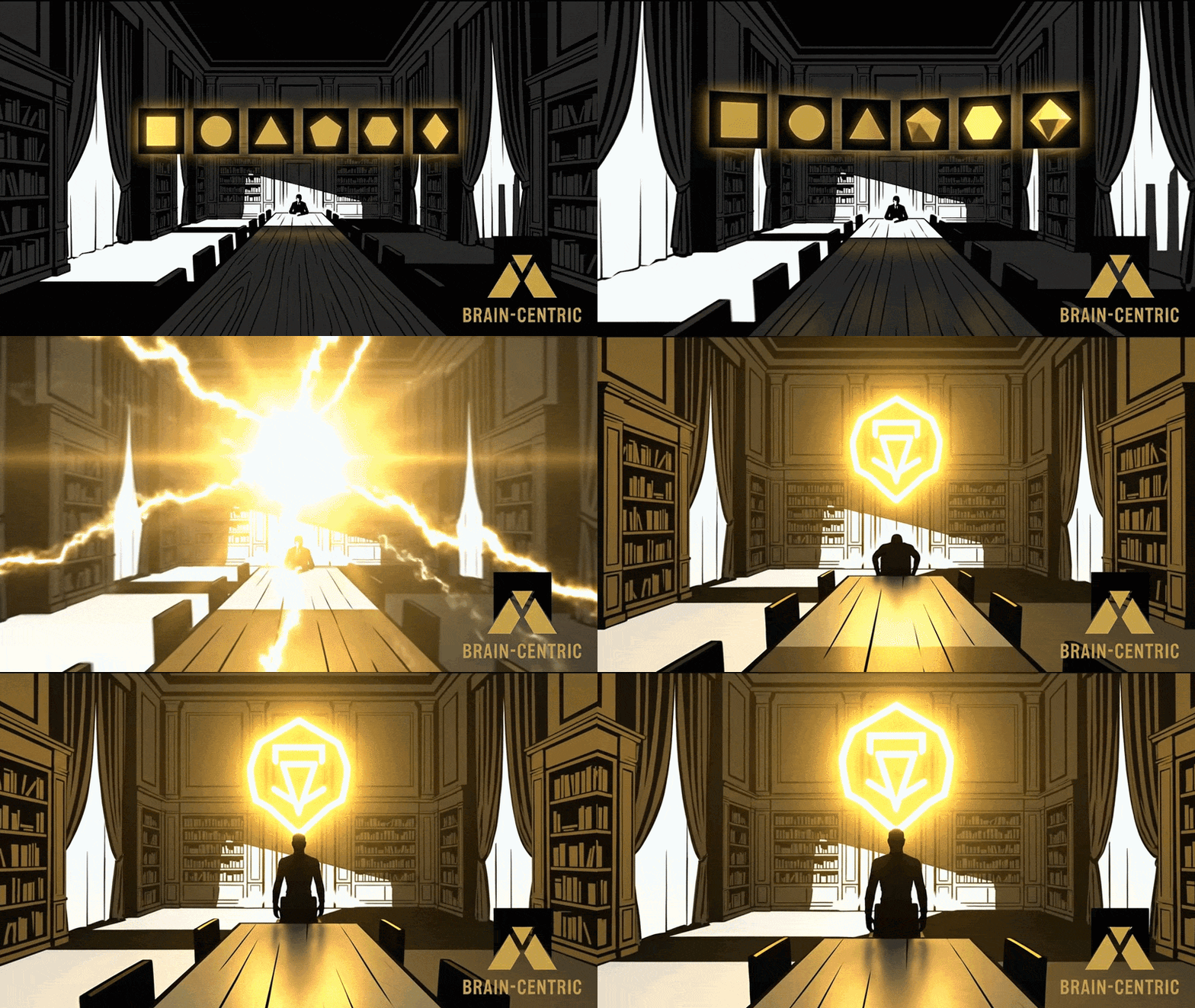
A theologian, a philosopher, and a psychologist walk into a bar. Somewhere important. The kind of place that smells of old books and built specifically for the kind photos that end up on the bookshelves of only those in the room. An economist, a physician, and a sociologist are already there. So are a psychiatrist, a public health researcher, and six others. Three rounds of structured disagreement until there was none.
And what did they land on?
Six factors that have nothing to do with your bank account, your diagnosis, your zip code, or your gym membership. Six factors that live entirely inside the cognitive and relational work of being a human being.
Every single one is a Premium Thinking output.
Meaning requires Evaluation…you have to weigh your life against something you value and render a judgment.
Life satisfaction requires the capacity to Evaluate your life as a whole, to step back, survey the full picture, and render an honest verdict on how you're doing against what actually matters to you.
Self-acceptance requires Analysis…an honest, clear-eyed assessment of who you actually are.
Autonomy requires the capacity to Create your own direction rather than simply follow one assigned to you.
Connection requires real-time social cognition: reading rooms, repairing ruptures, choosing vulnerability.
Happiness rounds out the list, and even that one is more cognitively demanding than it sounds.
The researchers are careful to distinguish happiness from the absence of sadness. Frequent positive mood, they note, is built through the other five. It follows from meaning, not from luck. And here is what the wellness industry never put on the label: your brain only consolidates new learning when you're in this state. Happiness isn't the reward for doing the work. It's the condition that makes the work possible.
Here is what the researchers left off the list.
Income
Housing
Physical health
Spirituality
Coping strategies
Subscriber count
These are what the study calls drivers…conditions that help produce wellbeing, but are not wellbeing itself. The lead researcher offered a useful frame: “gasoline helps a car run, but gasoline is not the car. A person can have money, a house, and a clean bill of physical health and still lack every one of the six factors that define being well.”
The reverse is also true, and this is the part worth noodling on.
The study confirms that positive mental health is entirely separate from mental illness. A person managing depression or anxiety can simultaneously have high wellbeing because wellbeing lives in a different register. It lives in whether life feels meaningful. Whether you accept yourself honestly. Whether the people around you matter to you and you to them.
None of those things can be prescribed. None can be generated by an algorithm.
AI can scan your sleep data. It can surface a meditation at the right moment. It can organize your calendar to create more margin. These are real contributions. They clear the decks.
But the decks get cleared so that you can do the work that science now says actually constitutes being well. Meaning-making. Honest self-reckoning. Showing up for the people who need you. Deciding what kind of life you want and then pointing yourself toward it.
That work has a name. Premium Thinking.
Premium Thinking leads to wellbeing. Science just confirmed it.
Wellbeing, as science now officially defines it, is a Premium Thinking state.
You can't outsource it. You can't automate it. You can't buy it with income or unlock it with a diagnosis cleared. It has to be built, deliberately, from the inside, using cognitive capacities that are distinctly, irreducibly human.
The researchers close with a line that deserves a moment: "You can't build what you can't define."
They're right. And now that we have the definition, it points directly at what we already knew but haven't always said clearly enough.
Being well is an act of Premium Thinking. It always was.
One more thing, and this one is for a specific group of people who have earned the right to hear it.
There are practitioners around the world - chiropractors, many of them - whose clinic names include the word wellbeing. They chose it deliberately. It reflects something they genuinely believe about what they do for the people who walk through their doors.
They are right to believe it. What they offer matters.
And now they have something they didn't have before: a scientifically agreed definition of the word on their sign. Meaning and purpose. Life satisfaction. Self-acceptance. Connection. Autonomy. Happiness. These are the six pillars that 122 global experts converged on after decades of fragmentation.
A chiropractic adjustment can be a driver of wellbeing. Pain relief clears cognitive and physical bandwidth. A body that moves without restriction is a body more available for the work of living fully. But the adjustment itself - as powerful as it is - does not produce meaning. It does not generate self-acceptance or deepen connection or expand autonomy.
Those six things still have to be built by the person on the table.
Knowing the difference between a driver and the destination is not a small thing. It's the kind of clarity that changes how a practitioner talks to their patients, designs their programs, and ultimately earns the word they put on the door.
The definition exists now. That's the gift.
This is such an excellent distillation of what we really all need. 💫
Excellent article and think it could also be shared in EI/EQ groups.