

The Reason They Don't 'Get It' When You 'Give It'
AI can't do this, but you can...

Last week I showed you the Nested Egg. How to tame chaos into a structure any brain can receive.
This week: how to deliver it.
Why? You know why. Most training washes over a room like noise. Content lands on slides. Presenters present. Attendees attend. Everyone leaves with the same vague sense that something happened although almost no one can articulate what that something was or how it will improve or benefit them personally. They saw pretty slides with lots of info, the presenter seemed nice, what's for lunch?
The brain doesn’t receive information just because you present it. The brain receives information when it works for it.
I’ve been training 500 managers, 100+ each week, in four separate cohorts, and I watch the opposite happen. Every session. The thinking shifts with each very intentional step of the framework I use for every presentation. Personal understanding compounds through the design and the practiced thinking it delivers in a room where people can be themselves. Have fun, even.
Thursday, a manager wrote this in her evaluation: “The opportunity to participate without fear of making mistakes necessary to learn from.”
Read that again.
She didn’t say the content was good. She said she could think. She could be wrong and still be safe. And in that safety, she learned.
The current NPS for this training as I write is +64. For context, anything above +50 is considered excellent. Above +70 is world-class. We’re knocking on that door.
But NPS only measures sentiment…did I like it enough to tell others about how great it was. What measures learning is participants consistently reaching proficiency by Day 2. Not exposure to the contend or attendance. Proficiency. That’s predictability. The Brain-centric pedagogic model works because it aligns with how the brain processes information. Every time.
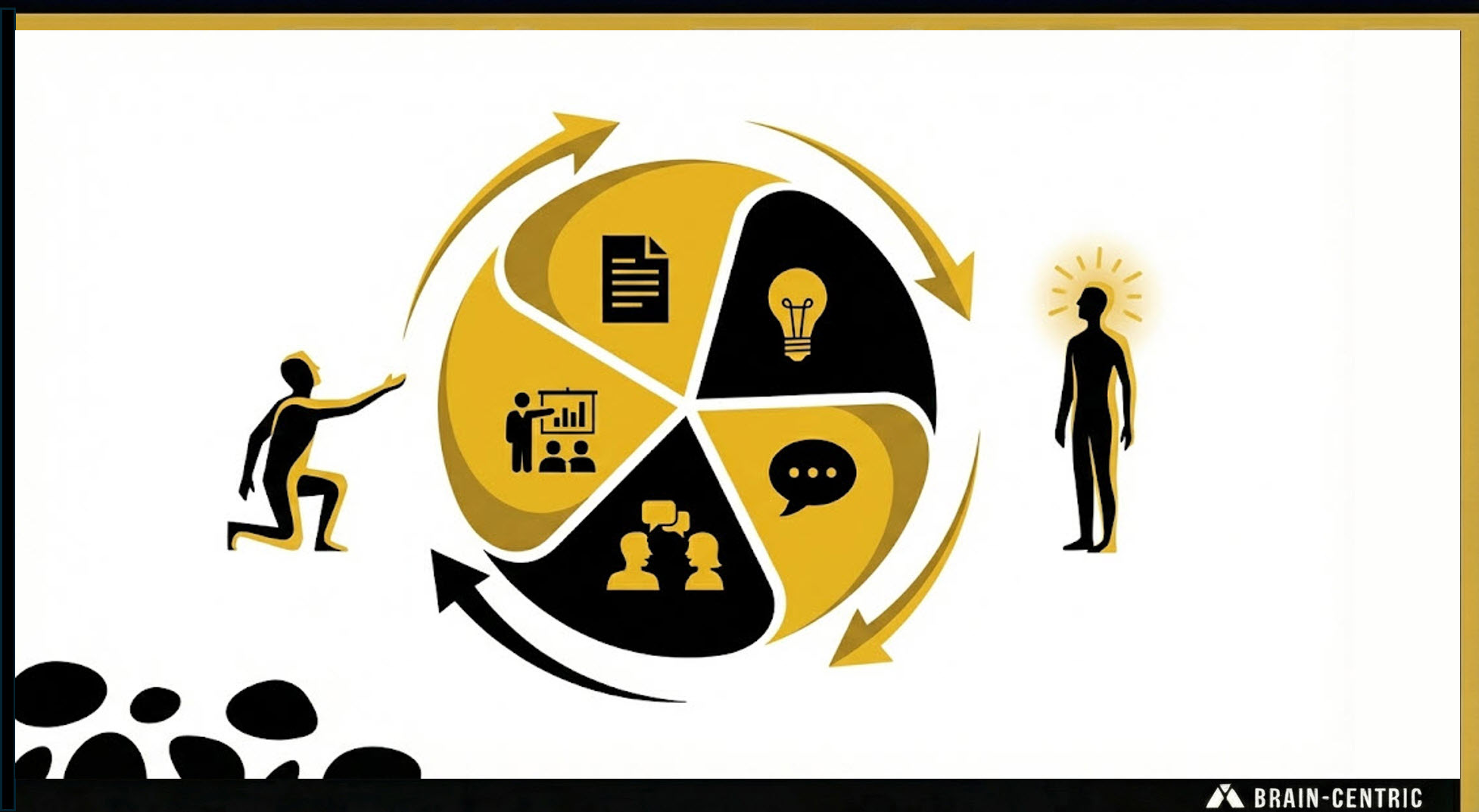
That framework is called the Challenge Wheel and visually, as a schematic, looks like this…

The Brain-centric Map To Understanding
The Nested Egg gives you your ‘point,’ your ‘Big Idea’ that you want to transfer…what the participants will walk away with understanding and using. The Challenge Wheel is the map to deliver it.
Here’s the structure from 30,000 feet…
First of all, your Big Idea doesn’t arrive as content to absorb. Instead, it's introduced simply, analogized in something you already understand, and then shown as what happens when this piece of knowledge is not a part of your world and the personal deficit it delivers by being absent. The true magic then happens when that Big Idea arrives as a small, attainable challenge in the form of the only question they’ll be confronted with during the presentation of this new information. Personally addressed to the learner. Instead of a terminal objective list of “here’s what you need to know.” it's a “here’s something you can figure out.”
That elegantly simple framing changes everything that follows. The brain engages differently with a challenge than with a lecture.
Participants are given sixty-seconds, in quiet, to write their thoughts on paper, no apps, as to how this challenge, if attained, will fit in their world. Nobody but them will ever read those thoughts, this documents their thinking for themselves. The ‘writing’ is intentional.
Regardless of delivery - in person, online ( synchronous or asynchronous) - multiple perspectives present themselves, one after another. Each one a possible answer to the challenge. Each delivered through novel media, fresh engagement, unexpected insight. These short, seldom more than three to five minute engagements aren’t repetitions of the same point. They’re different angles on the same truth, activating different parts of the brain.
After these perspectives are delivered, the room goes quiet and the learner reflects. Three neurologically intentional questions. Answered for themselves. Not performed for the room. Not graded. Just thinking, on paper, two minutes in private…but these thoughts they do share…by talking. With a partner. With a small group. Space to be themselves, try out their thinking, hear it challenged, revise it. The ideas get pressure-tested before they ever hit the larger room through casual conversation about their replies to the three questions:
What was surprising?
What did I already know and now see differently?
What do I still need help with?
After this discussion, only then do they report out. By the time someone speaks to the group, they’ve already processed. Already refined. Already owned the thinking. They’re not being put on the spot. They’re sharing what they’ve built.
No ambush, amygdala hijacks, red ink or freezing under pressure. Just learning, understanding, and making sense of the information as casually as recalling memories with a buddy from your childhood.
Why Brain-centric Works When Other Methods Don’t
Damn near all training makes one fatal mistake: it delivers content, tons of content, and hopes for retention.
The Challenge Wheel inverts that ‘tell all’ sage-on-the-stage default. It creates the conditions for the learner to arrive at understanding. The content doesn’t land on them. They reach for it.
This is not memorization as you were taught to learn. Memorization is fragile, flawed, and disappears quickly with time. It lives in short-term storage in your noggin and evaporates under stress.
The Challenge Wheel delivers understanding. Understanding is durable. It integrates with what the learner already knows. It becomes available when they need it, in contexts they’ve never rehearsed, because they built it themselves.
The most beautiful aspect of this model is it has infinite variations so long as the core maxims are followed in the correct order and at the right time. I’ve used it for two-day leadership intensives, fifteen-minute micro-sessions, and twelve-week enterprise rollouts. For senior executives and frontline supervisors. For technical content and emotional intelligence. The specific activities change. The timing flexes.
What stays constant is the effect: the right amount of new information, at the right time, for a consistent positive outcome that you identified by performing the Nested Egg. Before this Challenge Wheel is ever employed on your audience, you know your Big Idea, what your audience must comprehend to understand that Big Idea, and the prioritized elements that, if experienced, will lead to that Big Idea being internalized and adopted as their own. Only with the Nested Egg’s output can you develop your class, presentation or pitch using the Challenge Wheel to reach the measurement you said you needed during the Nested Egg exercise.
You can’t change how the brain processes information. But you can design for it. The Challenge Wheel framework follows the map of how your brain adopts the information that makes you ‘you,’ and it works every time. Every. Time.
I’ve been putting this process for you in the context of training 500 managers across North America for a Fortune 500 client. But the Challenge Wheel isn’t limited to corporate learning.
Any time you need someone to think differently, the same principles apply.
A team meeting where you need buy-in, not compliance. A strategy session where the answer has to come from the room. A difficult conversation where the other person needs to see something they’ve been avoiding. A conversation with your child.
You can even use it on yourself.
That decision you’ve been circling? That career question you can’t resolve? Frame it as a small challenge. Seek out multiple perspectives. Reflect before you discuss. Let the thinking compound. The brain doesn’t care whether the facilitator is you or someone else. It processes the same way.
We're Wired to Wonder
I recorded a short video on my YouTube channel explaining the value of a small, attainable challenge and what it does to a person once presented. It’s like rocket fuel for learning…
The Nested Egg tames chaos into structure. The Challenge Wheel delivers that structure so the brain receives it.
Together, they form the foundation of every curriculum we build for partners. Every presentation. Every communication of consequence where the stakes are real and confusion isn’t an option.
These two frameworks are core to our Brain-centric training and certifications. Not because we invented them to be proprietary. Because they work. Predictably. At scale. Across industries and audiences and levels of complexity. Every time.
AI can generate content in seconds. It cannot generate understanding. Understanding requires the learner to work for it, in safety, with space to be wrong and revise and own what emerges.
A Brain-centric Instructional Designer (BcID), the Masters of this framework, enable Premium Thinking in their audience and understanding in their brains. That is why Certified BcIDs are in such high demand. No algorithm replicates it.
I love this question, "What did I already know and now see differently?" - what a fantastic way to open up the subconscious to a new truth.
But what is so power about your approach is that it makes the information tangible by allowing us to paly with, interact with, and build with the information.
Truly changes the way that I think about learning.
And second I want to hit on this statement, “The opportunity to participate without fear of making mistakes necessary to learn from.” because that resonates deeply with me. I've been in positions were I was so fearful of making a mistake that it compromised my work.
I've saved this as something to try in my next editing process! My husband is very good at this, and I have always admired it as a skill - he says he just uses it as a way to deflect attention or fill in awkward gaps but the surprising question makes people remember "the funny thing you said" or "remember that time you brought to work that back to front bike and tried to ride it in your presentation about xyz?"
Hope your training is going brilliantly, Rich!